

WHO'S AFRAID OF
(PREMATURE)
ANTI-FASCIST JEWELLERY?
From LOST OWL'S...
"A HISTORY OF SOLIDARITY AND RESISTANCE JEWELLERY"
This is the season one finale of Lost Owl's "A History of Solidarity and Resistance Jewellery".
- Ceres Confronts the Capitalist Patriarchy
- The Ring is in my Eye, but I, I am also in the Ring
- The Perfect Chain, a Chain Never and Nowhere Interrupted
"At times, to be silent is to lie. For silence can be interpreted as acquiescence. "
—attributed to Miguel de Unamuno
Introduction
A Pendant, and the bombs in Bilbao
“The neighbourhood children got together and spoke in subdued voices as they watched their elders. Their minds on the bombardment, they asked themselves what it would be like.”
One of those children, in the besieged city of Bilbao in the winter of 1874 - February or early March perhaps - would grow up to be one of Spain’s most celebrated authors.
He was 10 years old at the time of the siege.
The above quotation is from his novel “Peace in War” - an account of the 71 day siege during which, according to the Museo Vasco de Bilbao…
“the Carlist batteries fired 5,369 shells, 1,307 cannonballs, 107 grenades, and two canister charges into the city, for a total of 6,785 projectiles—equivalent to 280 tons of iron and 40 tons of gunpowder.”
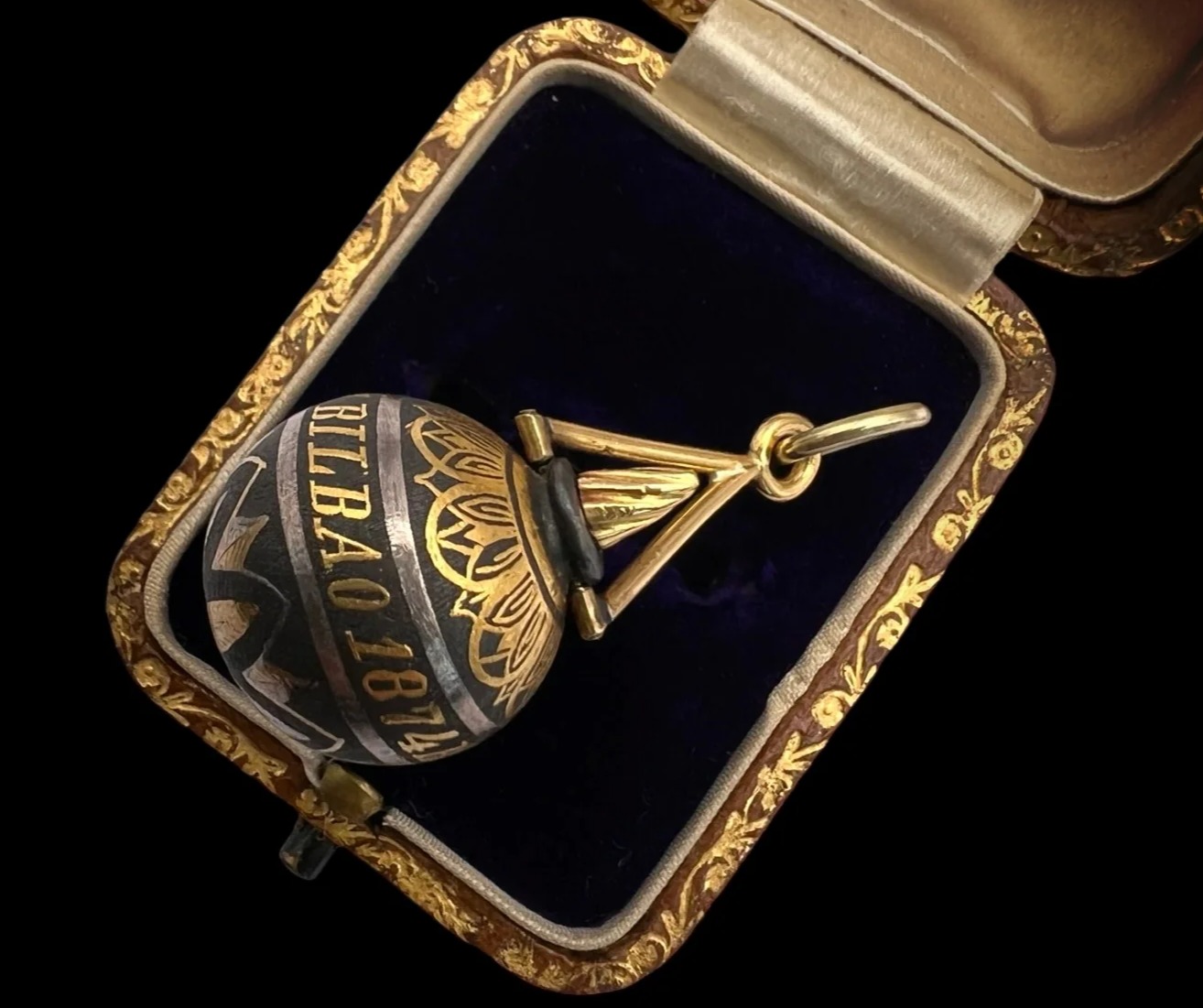
19TH CENTURY DAMASCENE ‘BOMBARDMENT OF BILBAO’ PENDANT from The Old Cut
But who was bombing Bilbao?
Who were the Carlists?
No.
Who are the Carlists...
Their flag - an ugly thing; a strange zig-zaging red saltire cross on a white background - is still raised by a powerful, if small, minority around Spain.
Their movement dates to the early 19th century, to a dispute over the ascension to the Spanish throne. It is perhaps the most tragic, stupid, and crucially important series of events in Spanish history.
Napoleon occupied Spain from 1808 to 1813. In May 1808, he forced the abdication of King Charles IV and his son Ferdinand VII (known as the abdications of Bayonne) and put his brother Joseph Bonaparte on the Spanish throne.
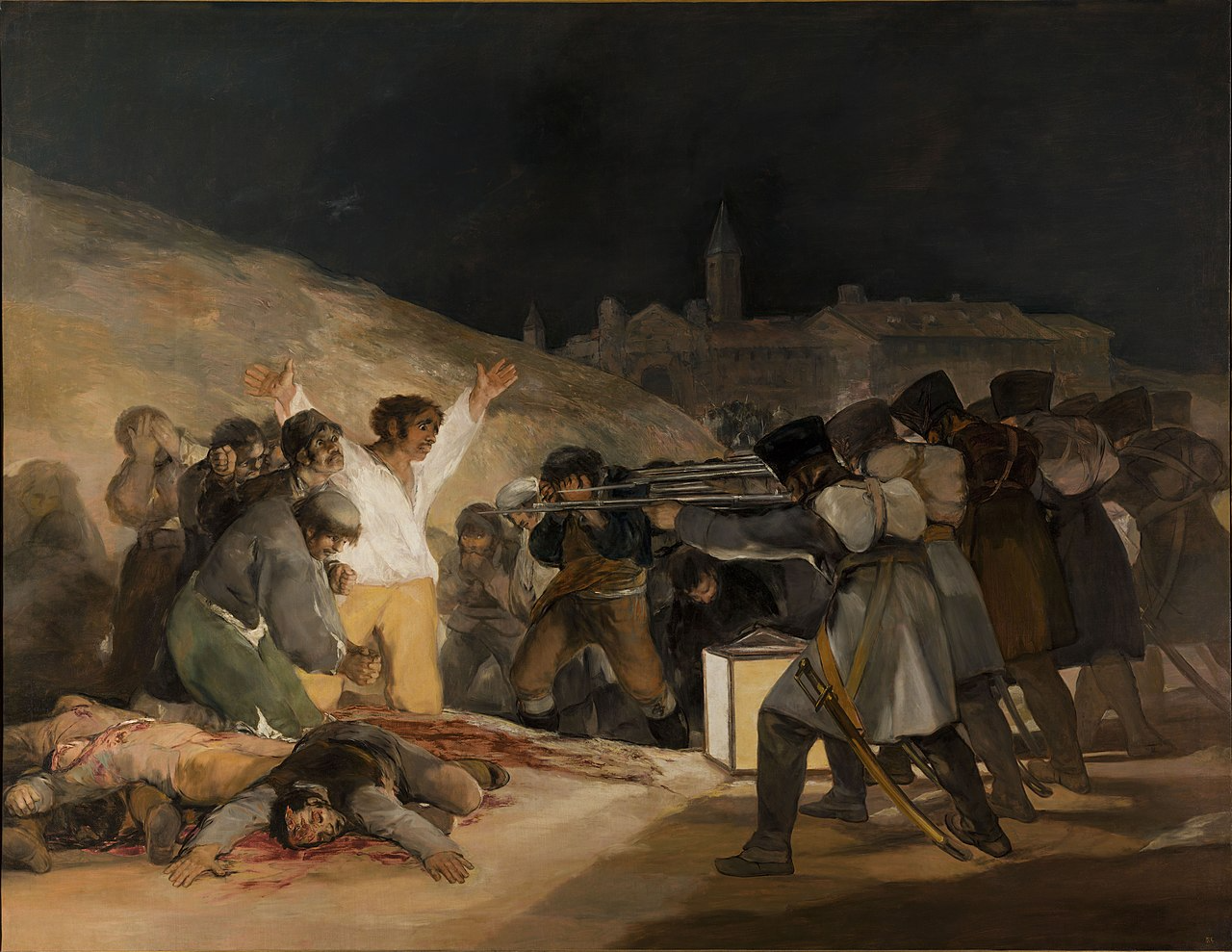
Goya's "Firing Squads of the 3rd of May 1808" in Madrid - Bonaparte's soldiers execute Spanish Guerrillas
Any regular reader of these blogs will remember that this is the moment when Napoleon inadvertently set back the science of platinum several decades - its melting and use in decorative objects had only been achieved in Spain under the funding of the abdicated Spanish King, Carlos IV. (See Lost Owl's blog, "The Platinum Collection")
With a Bonaparte now on the throne, Guerrillas around Spain took up arms to resist.
And with the Spanish monarchy in exile, liberal reformers seized the chance to write and ratify the celebrated Constitution of Cadiz - a landmark document that inspired liberal revolutionaries around Europe for decades to come. (We covered this in Castellani’s Revolution).
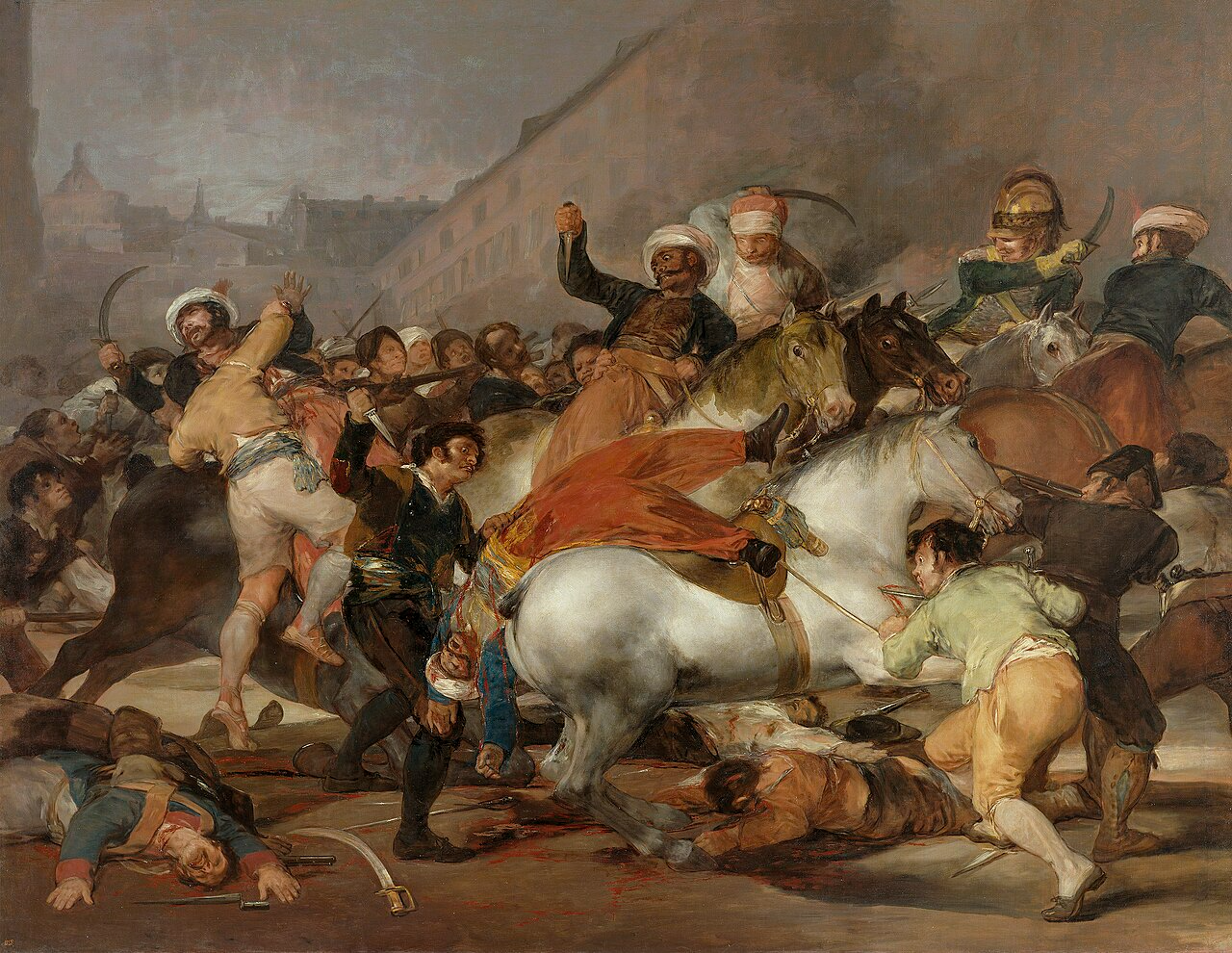
Goya's "The Second of May 1808" Spanish Guerrillas confront Napoleon's elite cavalry, the "Mamalukes"
Here’s the catch: Napoleon was taking heavy losses in Spain. So he withdrew and allowed Carlos IV's son, Ferdinand VII to return as King in late 1813.
Goya's paintings were commissioned as Ferdinand returned to Spain. The King was welcomed by centrist-liberals and conservative monarchists. But before Ferdinand even arrived in the capital, he abolished the 1813 Constitution of Cadiz.
If Ferdinand had not returned… if Napoleon had opposed the restoration, if the Spanish liberals had not been so naive as to think the King would accept a constitutional monarchy…
And the kicker: When Ferdinand died in 1833 he left his throne to his daughter, Isabella. Not to his brother, Carlos.
Isabella instituted liberal reforms, and the liberals rallied around her. Her uncle - now pretender King Carlos - was a reactionary and was rallied around by… the Carlistas: conservative monarchists who wanted a greater role for the clergy and the church, who opposed Isabella’s reforms and despised the legacy of the Constitution of Cadiz. And so began the first of three Carlist Wars.
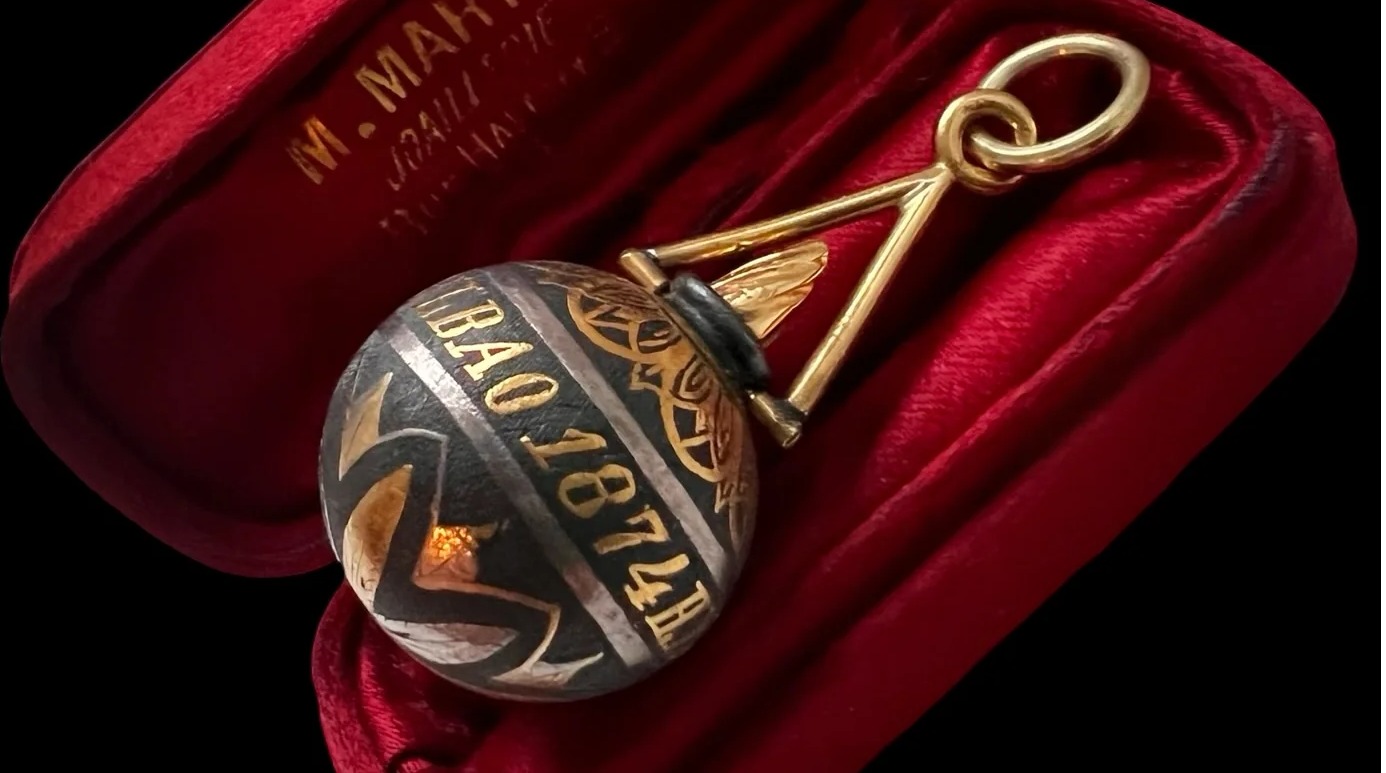
19TH CENTURY DAMASCENE ‘BOMBARDMENT OF BILBAO’ PENDANT from The Old Cut
“What was it all leading to? Why so much destruction? What was all this about Liberals, Carlists, Republicans, Monarchists, Radicals, Conservatives, and Progressives... the Liberty of Worship, Catholic Unity, Universal Suffrage...?”
- Miguel De Unamuno "Peace in war"
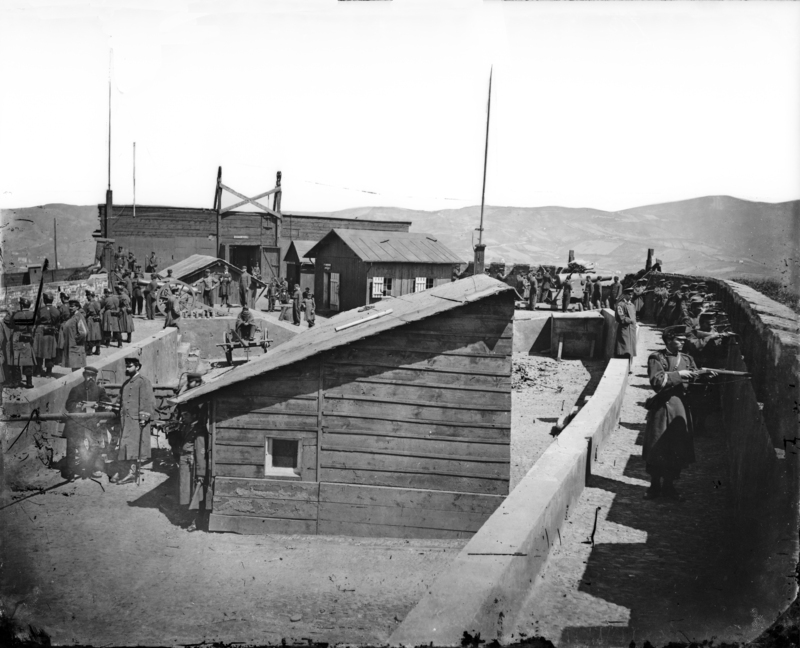
Bilbao, Winter 1874
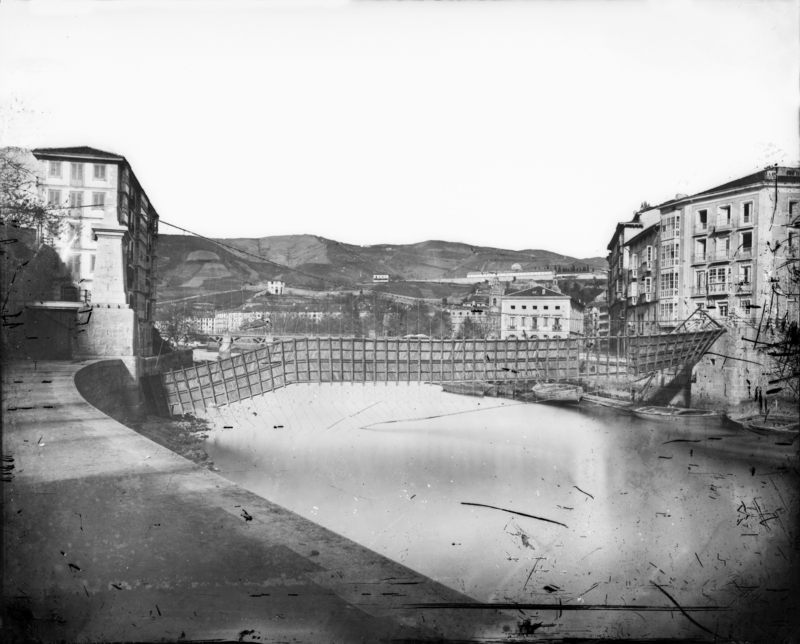
The siege of Bilbao (1874) was broken by Government forces, the pretender King was exiled to France - and the third Carlist War was the last.
But how can a war be won, how can a country heal when its population remains bitterly divided?
In Unamuno’s novel about the siege, Don Pascual is a devout, anti-liberal Catholic Priest, and a Carlista. After his side has lost the War, the priest reflects passionately on the events with his liberal nephew. Unamuno's words, Don Pascual's tirade at his nephew, were shockingly prophetic...
"Even though we're beaten, we're the victors...
Peace, peace! . . , a devilish pact with Hell... No, not peace, but continuous war with the enemies of God.... Lord Jesus Christ came not to bring peace to the world, but a sword and fire. He said so Himself. He came to sow dissension and war and to divide every house against itself....
Peace, peace! Yes, peace with God and peace with oneself, but war, continuous war against the wicked..."
Spain's troubles were far from over…
“Liberals, Carlists, Republicans, Monarchists, Radicals, Conservatives, and Progressives... the Liberty of Worship, Catholic Unity, Universal Suffrage...”
...the battle lines had just been drawn.
1936
¡No pasarán!
Alexander Calder was a multi-disciplinary artist who, like many North Americans during the 1930s, showed his support for the Spanish Republic.
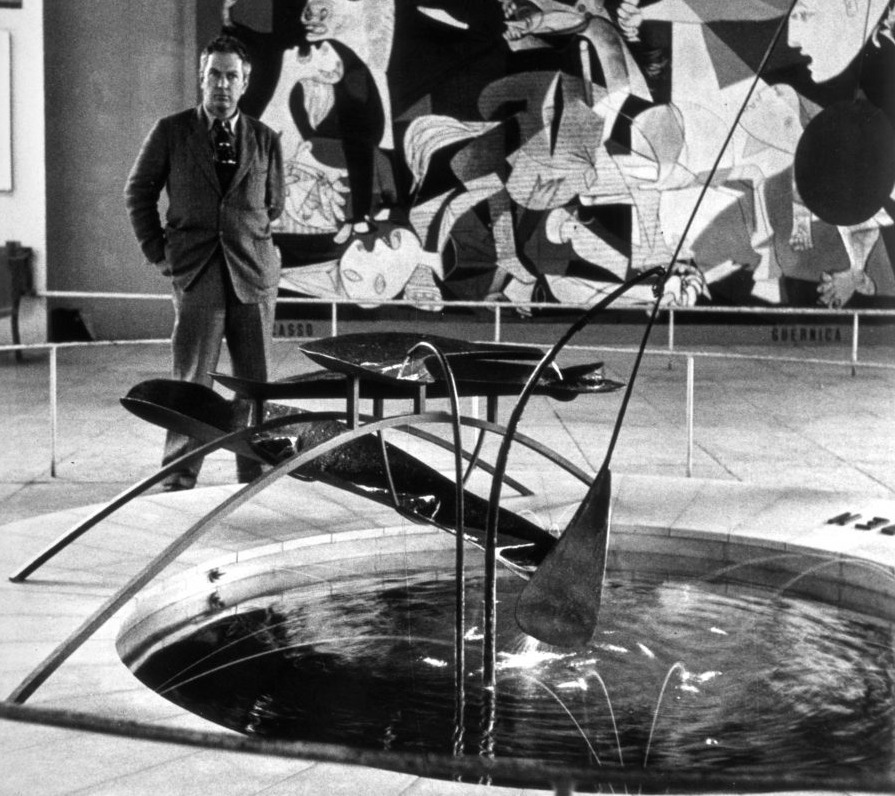
Calder's "Mercury Fountain" was commissioned by the Republican Government (Picasso's Guernika behind)
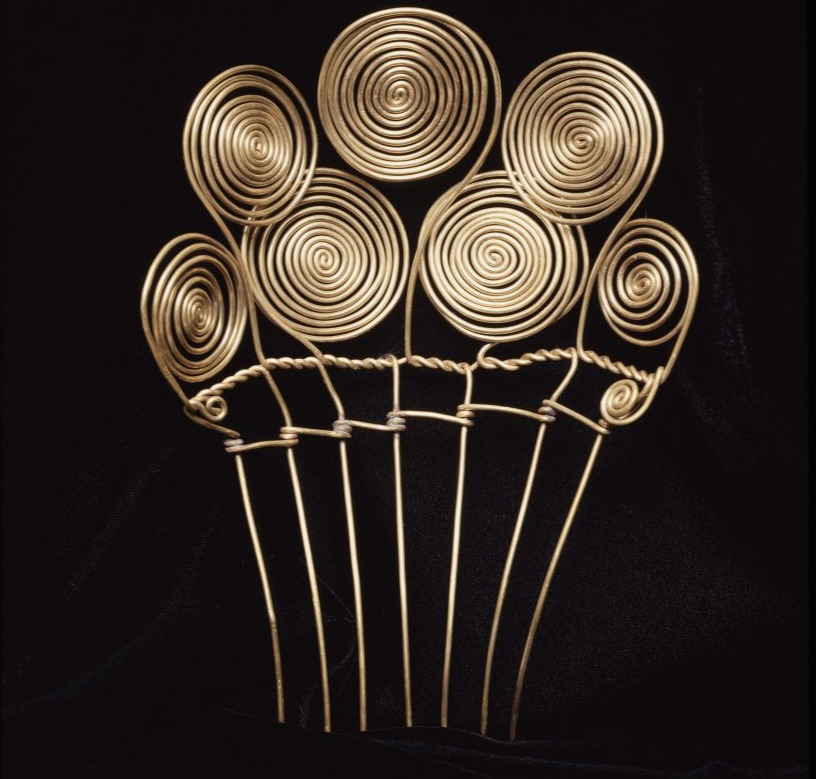
Calder's brass wire "Hair Comb" is very reminiscent of the traditional Spanish "Peineta," worn as part of traditional dress in the south of Spain (below)
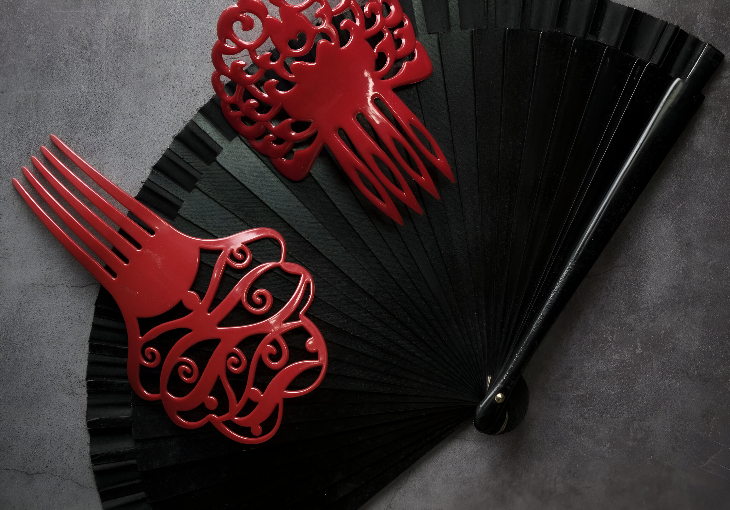
Alexander Calder also made pieces for Peggy Guggenheim
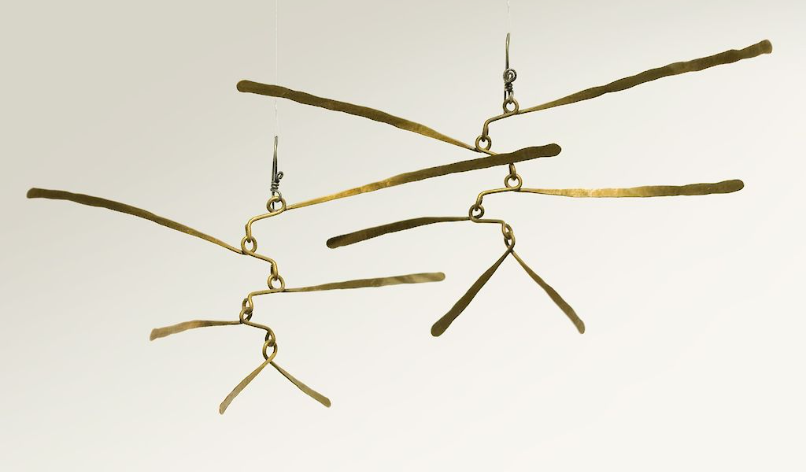
Calder's "Earrings for Peggy Guggenheim"
Around the same time, Peggy Guggenheim was sponsoring the autobiography of one of “the most dangerous anarchists in the United States,” a woman by the name of Emma Goldman.
In the U.S.A, Goldman used her publication "Mother Earth" to advocate for - among other dangerous and radical notions - women’s reproductive rights.
In 1936, Emma Goldman was exchanging letters with Mujeres Libres (Free Women) - a Spanish Anarchist Women's Association.
Mujeres Libres was the women's voice within the Spanish trade union, the CNT who, since decades prior, had been fighting in support of workers, for equal gender rights, an eight-hour working day, and for the abolition of child labour.
In February of 1936 the "Popular Front" - a left-wing coalition party - had come to power in Spain. The Popular Front (Frente Popular) included anarchist and communist representatives from the CNT and UGT.
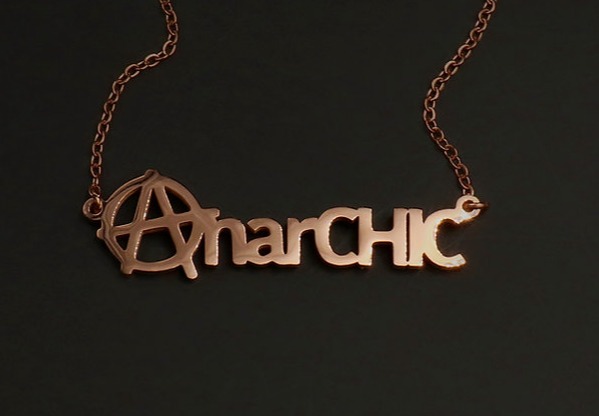
Topple and Burn: "AnarCHIC" - 18 inch chain, high quality surgical steel. 100% nickel & copper free.
At the time, the Spanish trade unions had almost 2 million card-carrying members. To put that in context, the Communist Party at its peak only reached around 100,000. And at the 1936 general elections, the Popular Front won a slim majority with 4.5 million votes.
In no small part thanks to many anarchists breaking ranks and participating in parliamentary politics. Why? Because...
"Their rival in the elections was the right-wing National Front, formed by the Bourbon monarchists, Carlist supporters, Don Carlos and Catholic clergy"
Yes. The Carlistas were back.
Having won the election, the left-leaning government attempted to pass a series of reforms from labour rights, to women's rights, to agrarian land reform.
"Collectivists from the CNT-UGT coordinated the construction of roads, schools, bridges, canals, and dams.
"In Catalonia, they ran the energy industry, creating the Central Committee of Workers, Control of Gas and Electricity. The CNT-UGT also established other facilities for the care and feeding of people by building chicken coops, barns, and dairies"
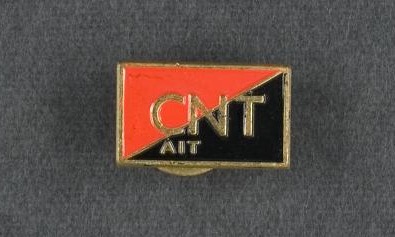
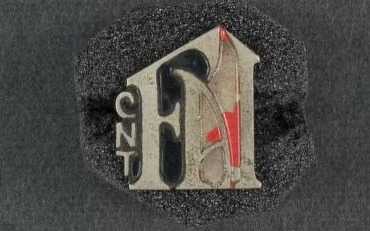
Pins from the 1930s: CNT (National Confederation of Labour) AIT (International Association of Workers) FAI (Iberian Anarchist Association)
But violence was erupting again around the country...
"...Liberals, Carlists, Republicans, Monarchists, Radicals, Conservatives, and Progressives... the Liberty of Worship, Catholic Unity, Universal Suffrage..."
Landowners were now being threatened by landless peasants - with the support of the Trade Unions - who were trying to collectivise and redistribute land.
The FE-JONS, the radical right, was happy to engage in street violence and assassinations. They were ultra-conservative Catholics, and as such their interests often overlapped with CEDA (the opposition party that had led the National Front in the 1936 election defeat).
If our objectives must in any case be achieved by violence, let us not stop at violence.
there is no admissible dialectic other than the dialectic of fists and pistols when justice and the Fatherland are offended.
- Jose Antonio Primo De Rivera - founder of the Spanish Falange (FE)
Recall the words of Don Pascual in Unamuno's "Peace in War" (1897)...
"No, not peace, but continuous war with the enemies of God.... Lord Jesus Christ came not to bring peace to the world,
.... He came to sow dissension and war and to divide every house against itself...."
And finally on July 17 1936, after years of tension, a conservative and deeply catholic general - well respected among the ranks of the conservative military - mobilised his forces in the North of Africa. It was a coup.
Hitler provided the planes to fly Francisco Franco's troops to mainland Spain. But as the Nationalists advanced on the Spanish Republic, the trade unions, too, mobilised. They beat back the fascists in almost all major cities, including Madrid and Barcelona.
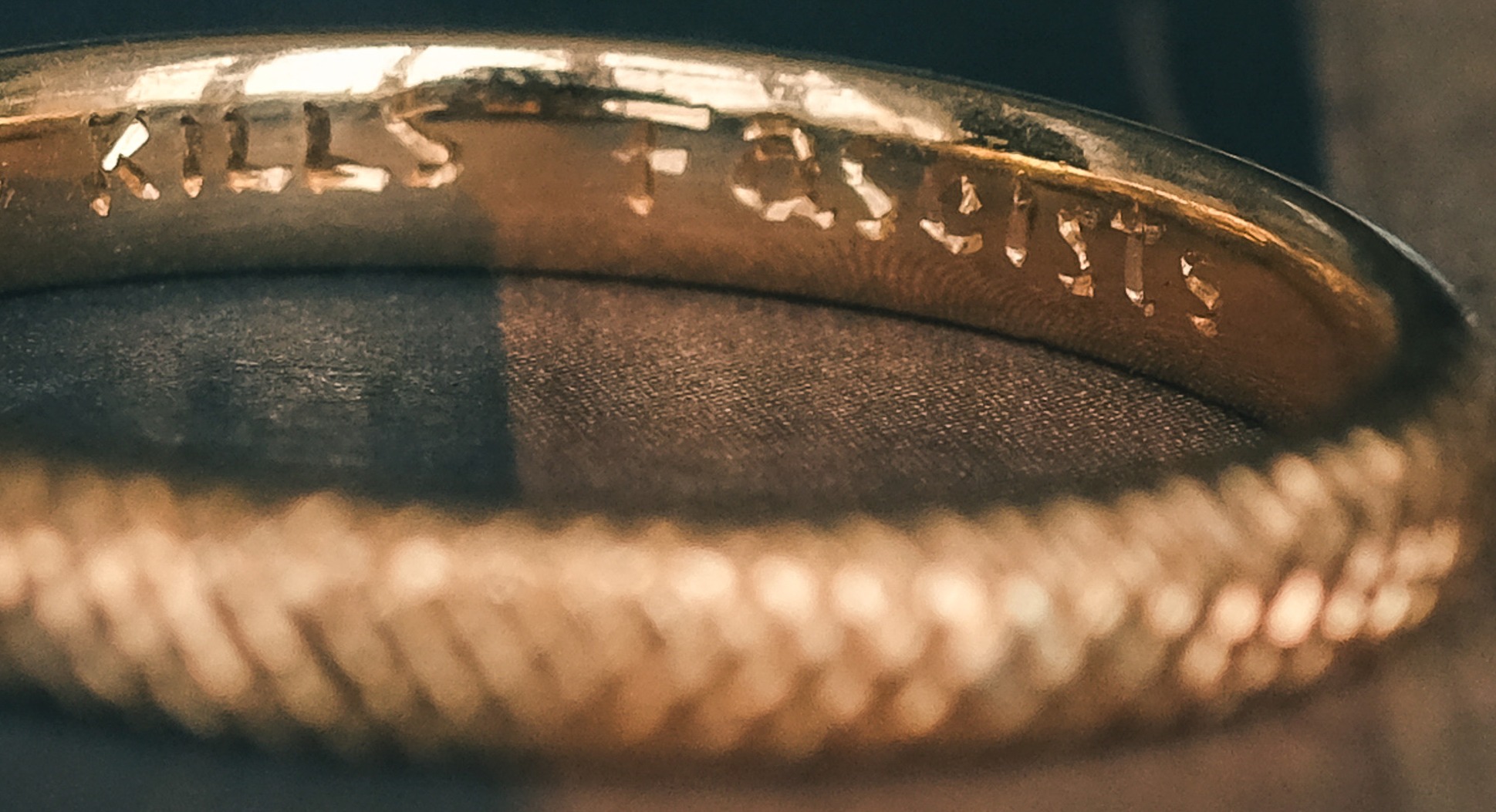
A Modern Posy Ring by LOST OWL; vintage 22k gold, bearing the inscription "This Ring Kills Fascists"
The ouroboros on the ring's exterior
The leader of the communist party - Dolores Ibarurri - gave a speech on July 19th 1936 celebrating the successful resistance against the first wave of Nationalist incursions:
“People of Catalonia, the Basque Country, and Galicia! All Spaniards!
The Communist Party calls you to the struggle. It calls especially upon you, workers, peasants, intellectuals, to take your place in the fight to crush the enemies of the Republic and common liberties.
Long live the Popular Front! Long live the unity of all anti-fascists! Long live the People's Republic!
The fascists shall not pass! They shall not pass!”
<< ¡NO PASARÁN! >>
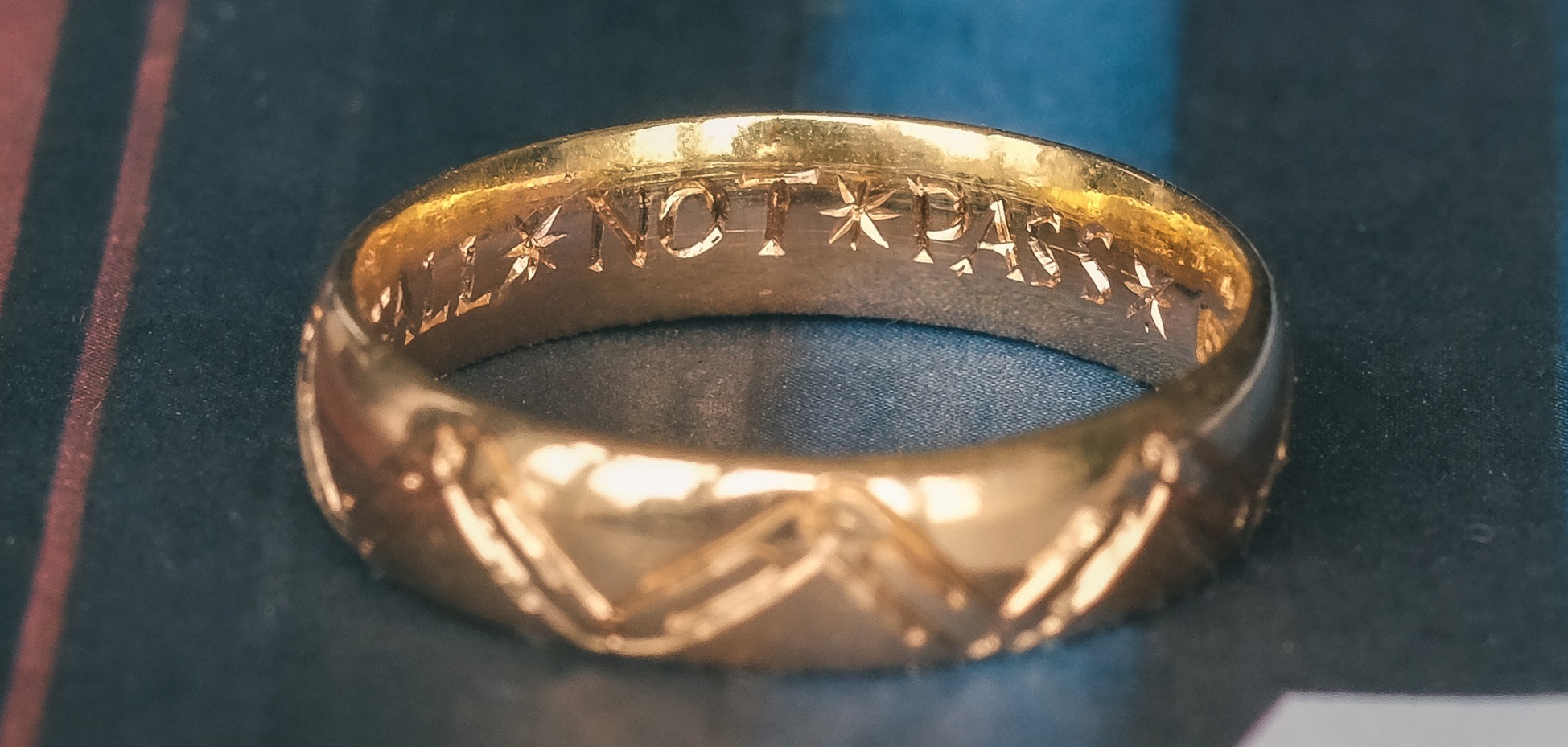
A Modern Posy Ring by LOST OWL; vintage 22k gold, (1939) bearing the inscription "They Shall Not Pass"
Dolores Ibarruri’s speech “They shall not pass!” would reach mythical status in the years to come.
But in reality, the communist party itself still had very little support in Spain - their membership was still minute compared to that of the anarchist trade unions who had been far more important in the resistance to the July coup.
And the trade unions were making material changes in people’s everyday lives....
In Barcelona the trade unions and the anarchists were now in control of the city. The city outlawed money, collectivised land, and created peoples’ committees to replace the government ministries.
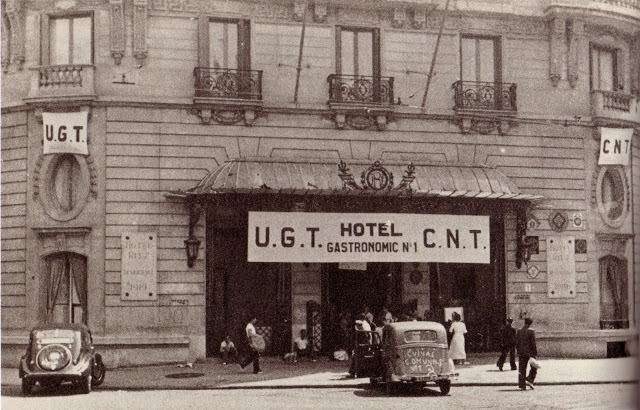
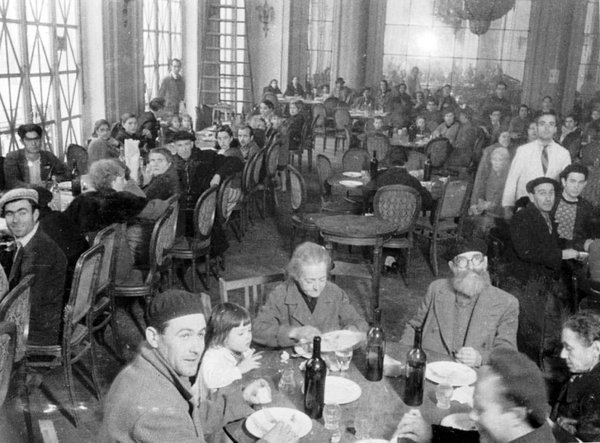
And in the summer of 1936, everyone in Barcelona, rich and poor alike - peasant, professor, and general secretary - could dine at the Ritz, paying in tokens acquired through their contributions to the community.
This was because The Ritz Hotel had been expropriated by the trade unions on July 22nd 1936 - a Wednesday. The Ritz was renamed “Gastronomic Hotel No.1”, under the leadership of the FOSIG Union (the Federation of Gastronomy Industry Unions).
The following Wednesday in a Spanish military barracks in Morocco...
A journalist from the Chicago Tribune, Jay Allen sat down with General Francisco Franco. Franco was coordinating the continued movement of his forces from North Africa to Spain.
It was just 10 days after Ibarruri’s "They Shall Not Pass" speech. It was 10 days after the coup had failed to take Spain's major cities.
In the interview, Franco was asked by Allen ...
“Now that the coup has failed in its objectives, how long will you keep up the massacre?”
Allen writes that Franco answered calmly at first...
“There will be no compromise nor truce. I will continue preparing my advance towards Madrid."
And then, writes Allen, Franco shouted...
"I will advance! I will take the capital. I will save Spain from Marxism at whatever cost.”
Allen: "That means that you will have to shoot half Spain..."
Calmly again...
Franco: "At whatever cost."
"It would have been better to be premature..."
In 1936, Miguel de Unamuo - the boy who had been 10 years old during the bombardment of Bilbao - was 72 years old and living in the University town of Salamanca.
He was the rector of the University; a widely read and successful author - profoundly important in Spanish cultural and intellectual life.
In the last years of his life he would watch Franco's forces closing in and arrive to his University campus in Salamanca.
Unamuno, as the coup was taking place, did not oppose it. He criticised both sides. He even, briefly, supported Franco's Nationalists. He had kept his position at the University thanks to them.
On the 12th of October of 1936 the Nationalists invited him to speak at an event at the University.
Unamuno was supposed to speak in support of Franco’s continuing efforts. At the conference, the General Millan Astray, one of Franco’s most decorated generals spoke, finishing with his infamous rallying cry ...
<< ¡Viva la Muerte! >>
"Long live Death!"
And Unamuno went off-script. In the crowded lecture theatre, he addressed General Millan Astray directly:
“Just now, I heard a necrophilic and senseless cry, ‘Long live Death!’
To me it sounds equivalent to "To Death with Life!"
...I must tell you, as an expert authority, that this outlandish paradox is repellent to me.
I can only explain it to myself by supposing that it was addressed to him (Millan Astray himself),
in an excessively strange and tortuous form, as a testimonial to his being himself a symbol of death."
Unamuno closed with his most famous (if perhaps apocryphal) lines...
"(Vencereis…) You will win, but you will not convince (...pero no convencereis).
You will win, because you possess more than enough brute force,
but you will not convince, because to convince means to persuade.
And in order to persuade you would need what you lack — reason and right in the struggle. "
Unamuno - often so prescient - this time had been unable to see what was coming. It would have been better to be premature.
Now, what he saw was that it was already too late.
A year later, Unamuno would be dead. And Bilbao would again be under siege again.
And this time, the city would fall.
Interlude:
Yale University, Connecticut, 1946
Knox tells the Chairman of the Yale Classics department of his role in the Second World War...
“In July 1944, I had parachuted, in uniform, behind the Allied lines in Brittany to arm and organise French Resistance forces and hold them ready for action at the moment most useful for the Allied advance.”
Chairman: Why were you selected for that operation?Knox: I was one of the few people in the U.S. Army who could speak fluent, idiomatic, and (if necessary) pungently coarse French… I had fought in 1936 on the northwest sector of the Madrid front in the French Battalion of the XIth International Brigade
Chairman: Oh, you were a premature anti-Fascist.
Knox writes...
“How, I wondered, could anyone be a premature anti-Fascist?
Could there be anything such as a premature antidote to a poison?
A premature antiseptic? A premature antitoxin? A premature anti-racist?
If you were not premature, what sort of anti-Fascist were you supposed to be?
A punctual anti-Fascist? A timely one?"
1936-7
Winter
Bernard Knox - the premature anti-fascist - George Orwell and Ernest Hemingway arrived at the end of 1936 in the International Brigades - volunteers from Canada, USA, Poland, France, Italy and Britain to help defend the Republic.
Knox was posted to Madrid. The fascists had the city under siege.
In the west of the city, the Republicans fought in the university campus of Ciudad Universitaria in room-to-room skirmishes against Franco's Nationalists in corridors where books were used as barricades.
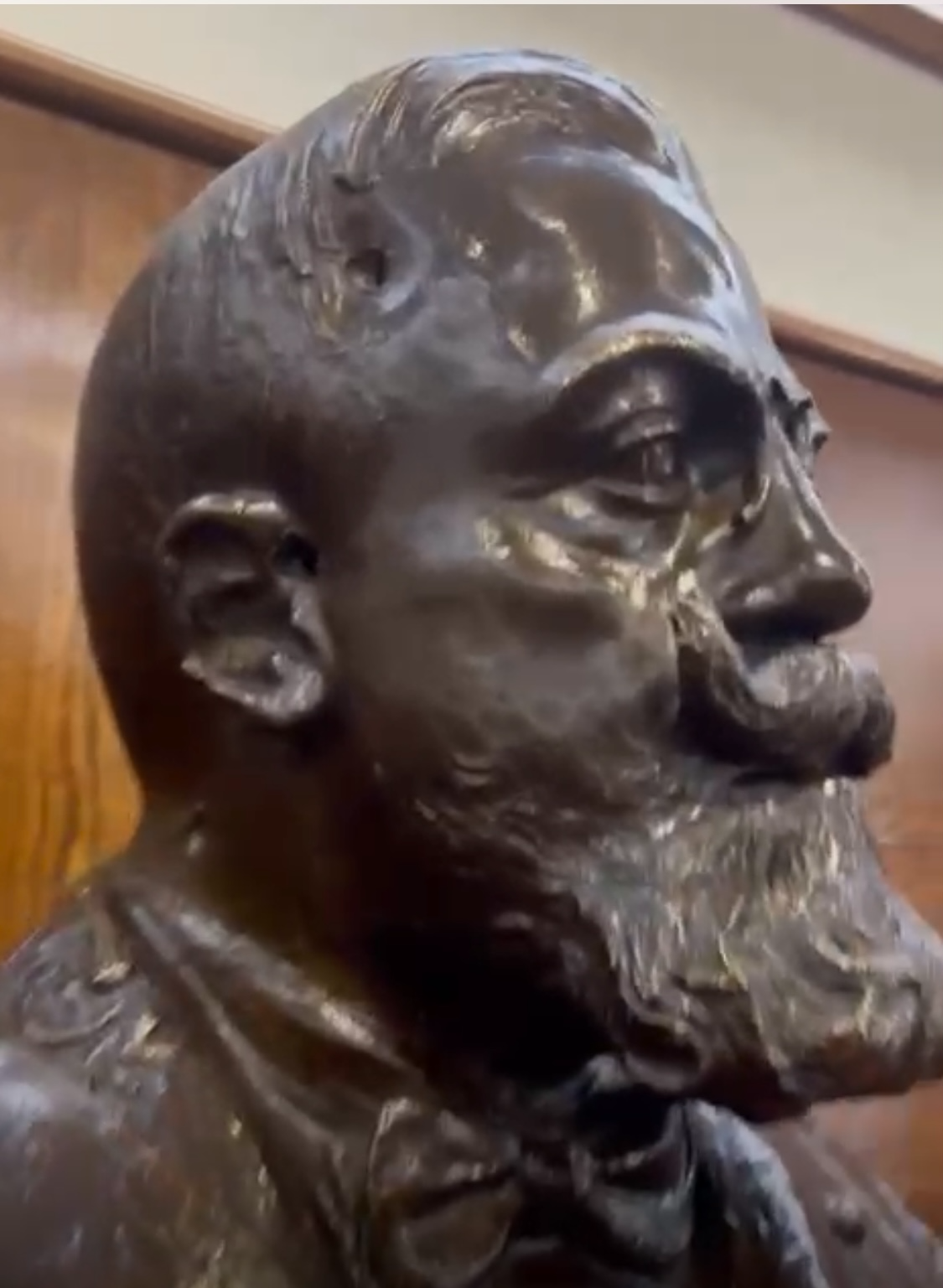
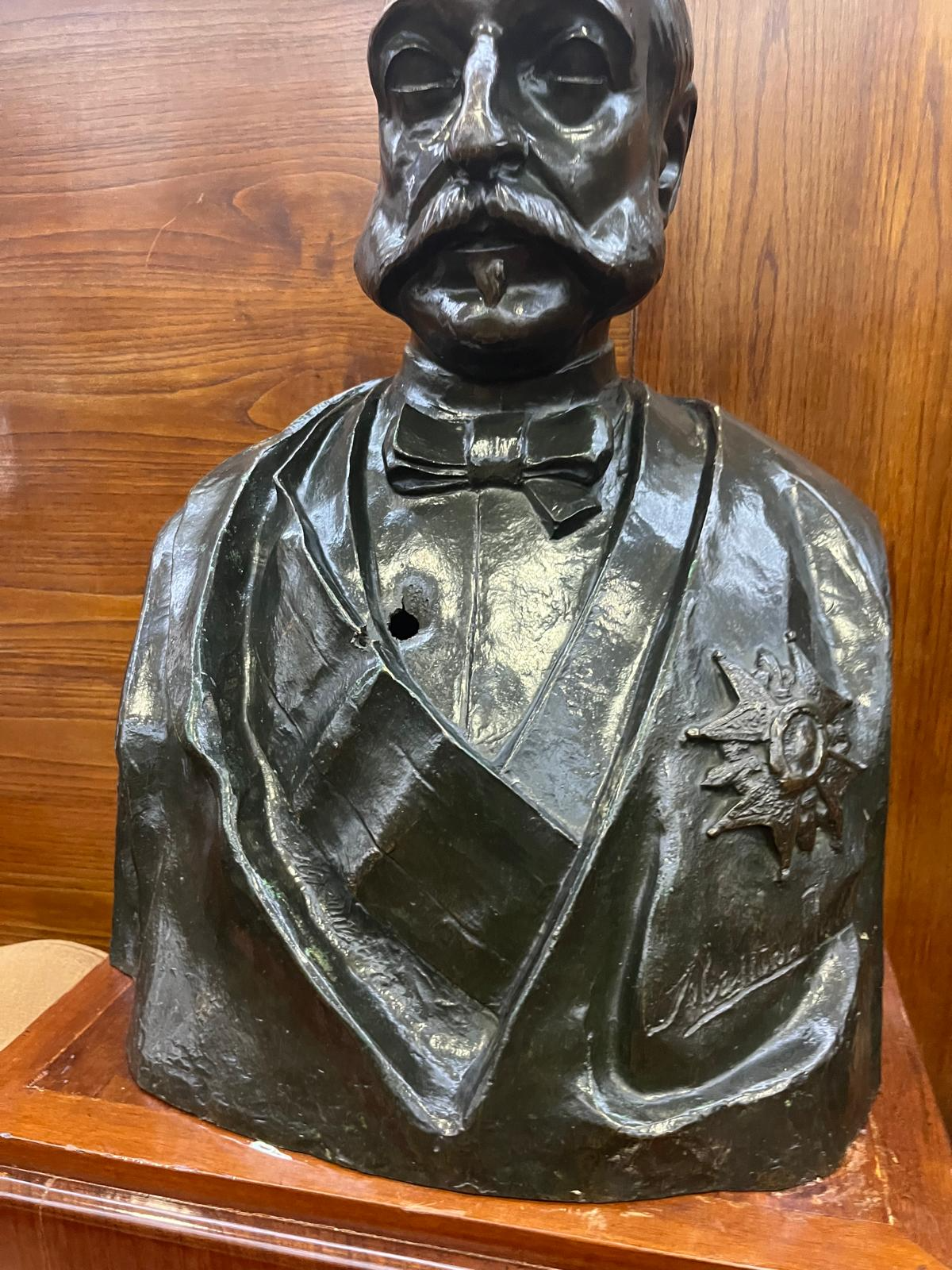
Bullet holes in the busts lining the corridors of Madrid's School of Agricultural Engineers
350 pages was a more-or-less safe length for a book to stop a bullet, Knox recalls.
His battalion pushed the fascists back and was moved further west to the front in Casa de Campo, in the Aravaca neighborhood where he was almost killed by a bullet to the neck.
He walked, bleeding, over six miles to a hospital in Las Rozas where a doctor asked his students, how many vital parts must the bullet have missed in order for the patient to have survived.
The siege of Madrid would continue for two more years.
1937
Knox writes:
" …as the European situation moved inexorably toward war, the British and French governments passed up one timely opportunity after another to become anti-Fascist…. They allowed Hitler and Mussolini to supply Franco with planes, tanks, guns and troops…. They remained silent while Mussolini conquered Abyssinia and Hitler annexed Austria."
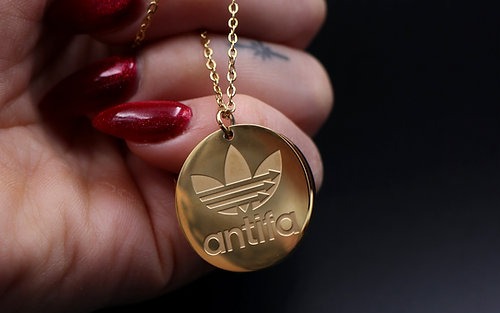
Topple and Burn: "ANTIFA" - 18 inch adjustable chain. Made from high quality surgical steel. 100% nickel & copper free. Gold/Rose Gold are 18k plated.
Soviet leader Joseph Stalin was the only actor on the international stage who was helping the elected government of Spain against the fascists, providing military support on the condition of a united left; a popular front.
But the republican government and the communist party wanted to show a more centrist stance, favourable to France, Britain and North America in the hope of receiving military reinforcement.
Envisioning that the war would soon spill out into Europe, the Spanish Republic aimed simply to keep up the fight until a, expected second world war broke out. Spain would thus become part of an allied coalition against European Fascism.
In April of 1937, the town of Guernika in the Basque Country, north of Spain, was raised to the ground.
The bombing of the civilian city was carried out by the Nazi German and the Fascist Italian airforces in order to pave the way for Franco to take the north.
It is both a mystery and a tragedy, - and a profound betrayal - therefore, that just as Franco was gaining ground, receiving increasing aid from the fascist coalition in Europe, the center left and the communists turned against the anarchists and the CNT.
And in the “May Days” of 1937, as documented in George Orwell’s “Homage to Catalonia”, the Collectives, the trade unions and its leaders were attacked by the Communists and the Republican Government.
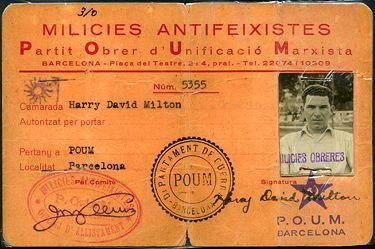
Milita card of POUM member Harry Milton. "On 20 May 1937, Milton saved George Orwell’s life after the writer was shot through the neck by a sniper on the Aragón front, by quickly stopping the bleeding."
The Russian-American anarchist and old friend of Peggy Guggenheim, Emma Goldman was still collaborating with the CNT and Mujeres Libres. bringing their struggle to the attention of anti-fascists around the world.
"Comrades, the CNT-FAI are in a burning house; the flames are shooting up through every crevice, coming nearer and nearer to scorch our comrades. At this crucial moment, and with but few people trying to help save our people from the consuming flame...
...I mean to strain every muscle and every nerve to make known, in as far as my pen and voice can reach, the great moral and organizational force of the CNT-FAI and the valour and heroism of our Spanish comrades."
The CNT and the FAI, along with other anti-Stalin Marxist militias like the POUM (with whom George Orwell fought) had not wished to collaborate with Stalin. The Communist Party and the Republican Government saw no alternative.
After the May Days the anarchist movement effectively collapsed - their key infrastructure in the city of Barcelona and the land they had given over to anarchist collectives in the countryside were taken by the state.
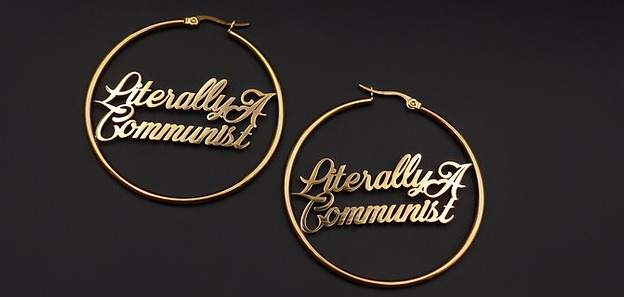
Topple and Burn: Literally A Communist Hoops. Pair of hoop earrings. 5cm diameter, high quality surgical steel. 100% nickel & copper free.
With little-to-no International support and with continued infighting, The Spanish Republic fell region-by-region until Franco took the Spanish capital, declaring victory in March 1939.
The next month Hitler gave orders to draw up plans to invade Poland.
“It would have been better to be premature"
...wrote Knox.
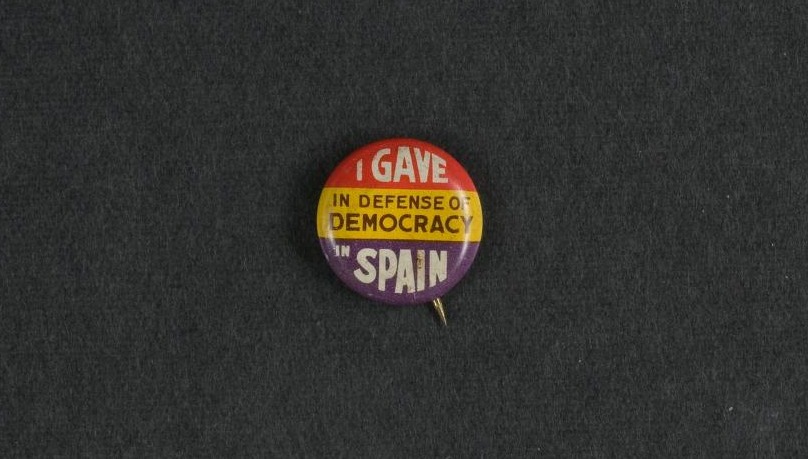
Pin with the Spanish Republican Flag, date unknown.
Conclusion
First they came for the communists then they blacklisted a jeweller
Why, according to Knox, would it “have been better to be premature”?
The Spanish Civil War had been a critical front in a far larger conflict.
After the First World War and the Russian Revolution, the workers of the world were uniting. Just as the CNT in Spain and the reduction of the working day to eight hours, The Biennio Rossi ("Red Biennium" / "Two Red Years") in Italy had seen Italian workers win multiple wage rises.
"emboldened by the new economic precedents of the mobilization effort, workers in Europe spoke with a stronger and more radical voice... They consolidated collective power through unions, parties, guilds, and rank-and-file institutions to control production."
- Clara Mattei
But there would be a backlash. Clara Mattei describes the nature of this class war in her book "The Capital Order: How Economists Invented Austerity and Paved the Way to Fascism". She show how austerity politics were used - in the guise of "sensible economic policy" to break the workers movement.
"Austerity as we know it today emerged after World War I as a method for preventing capitalism’s collapse...
... Under a veneer of a-political science, technocrat economists were undertaking the most political action of all— bending the working classes to the wills and needs of the capital-owning classes for the enrichment of a small minority." (page 12)
This was done through a happy allegiances with fascists.
“If I had been an Italian I am sure that I should have been whole-heartedly with you from the start to finish"
- Winston Churchill's address to Mussolini, Rome, Italy 1922
During the Spanish Civil War, governments in the west expressed their anti-leftist agenda through silence and non-intervention. As Unamuno himself said...
"At times, to be silent is to lie. For silence can be interpreted as acquiescence."
The French, the American, the British and Canadian who come to the aid of the Spanish Republican cause, in the International Brigades - trade unionists and feminist activists, artists and intellectuals did so in defiance of the laws of their governments, which all enacted non-intervention policy making it illegal for citizens to join the cause.
Shortly after the International Brigades arrived in Spain, in 1937, the Nazis forced the Berlin Bauhaus to close, denouncing it as degenerate and communist art.
A decade later, the U.S. government did the same thing in California.
Margaritte de Patta and her husband gave design classes in the The California labor school (CLS). The school taught the Bauhaus ideals of high-quality and accessible design. It collaborated closely with and provided education for workers and workers’ unions.
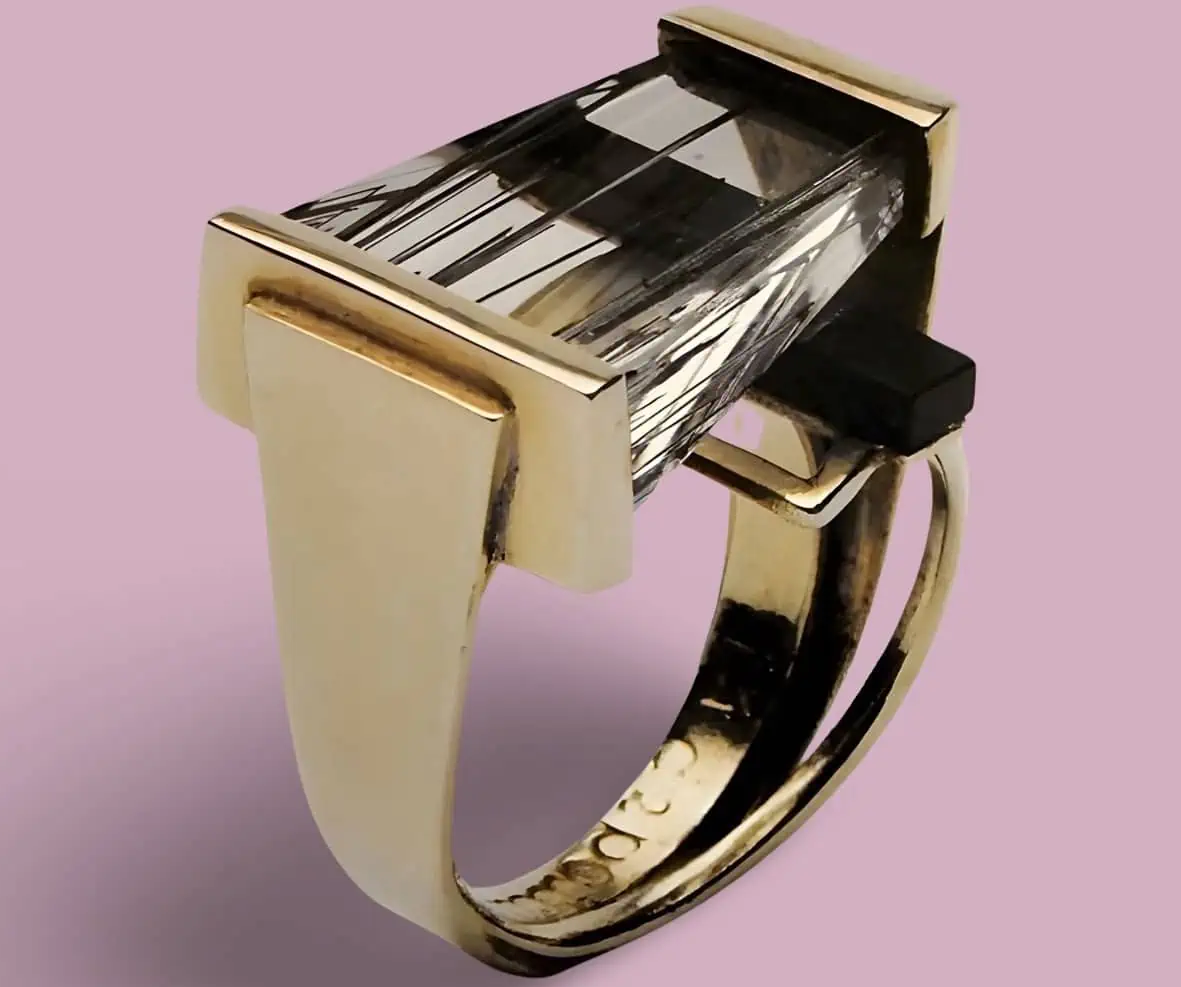
Margaritte De Patta was an extraordinary jewelry maker and designer who had worked with tiled Bauhaus artists from Germany. (See our article Post-war Modernism and Talismanic Numinous for more on De Patta)
1947 the first major Union-busting law - Taft-Hartley Act - was passed. And it was around this time that de Patta and her husband were blacklisted.
The CLS - a hub for exiled bauhaus artists and crafts-people - was closed due to its suspicious and un-American political activities.
Around the same time, Haiti finally paid off its debts to France.
The new leader of Haiti and Yolette Leconte - the first lady - were admired by the U.S. government for their staunch positions against the workers’ unions, the left, the communists and the socialists of Haiti. Yolette was the great-great-grand niece of the Haitian revolutionary Jean Jacques Dessalines - the ex-slave who had declared Haiti free and independent after the defeat of Napoleon back in 1804. The debts had been imposed by France in the 1820s, to compensate the European nation for the loss (liberation) of its slaves and colonial properties.
The dates the piece below from Yolette's collection appear to mark the years of Haiti's crippling debt repayment - commemorating the terrible price that the Haitian people continue to pay - the price for their freedom...
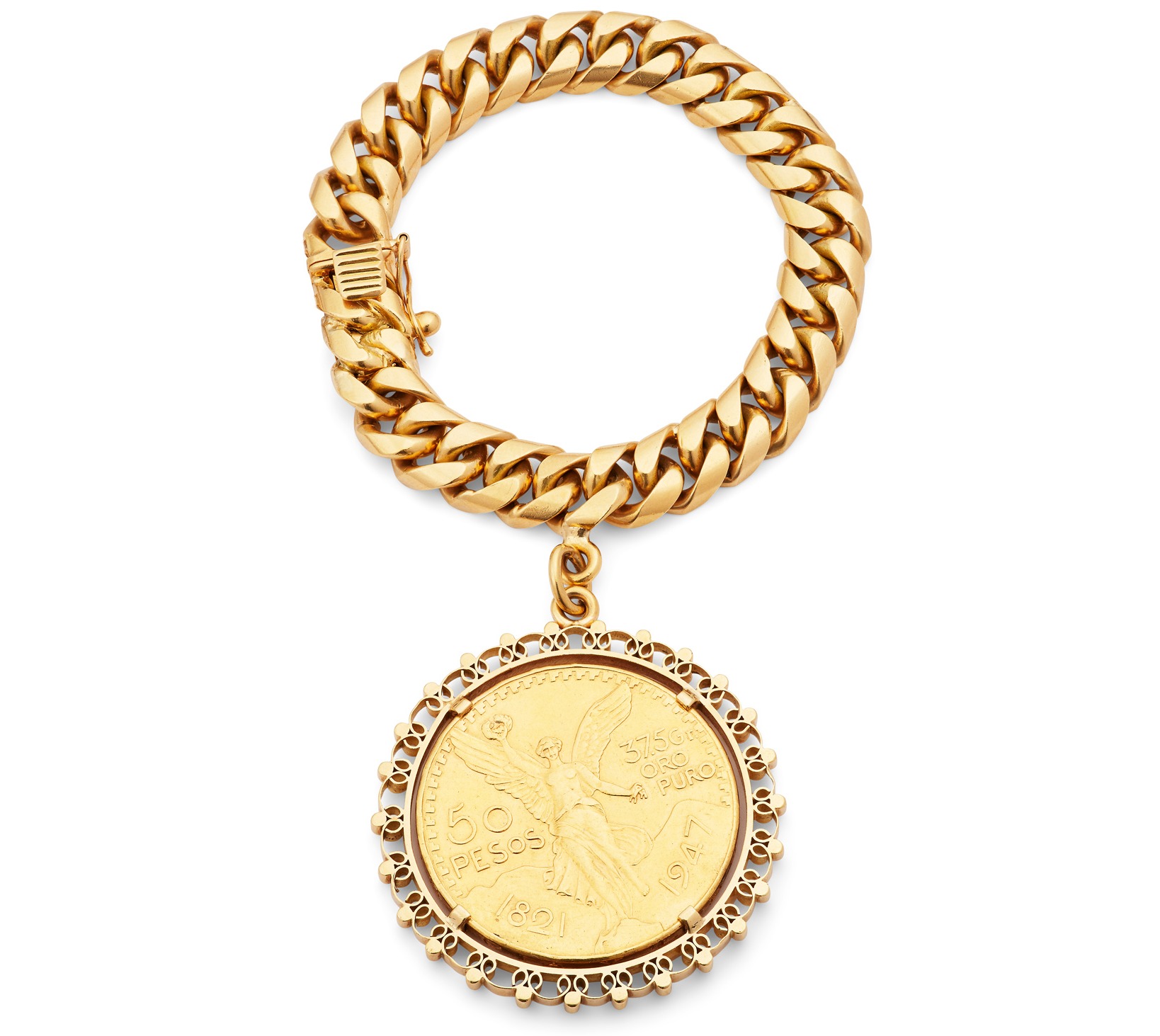
Another item of Yolette's personal jewellery collection commemorates the July 1956 Panama Congress, held to commemorate Simon Bolivar’s 1826 Panama Congress, at which he had hoped to create a united American front - a post-colonial anti/imperial third world.
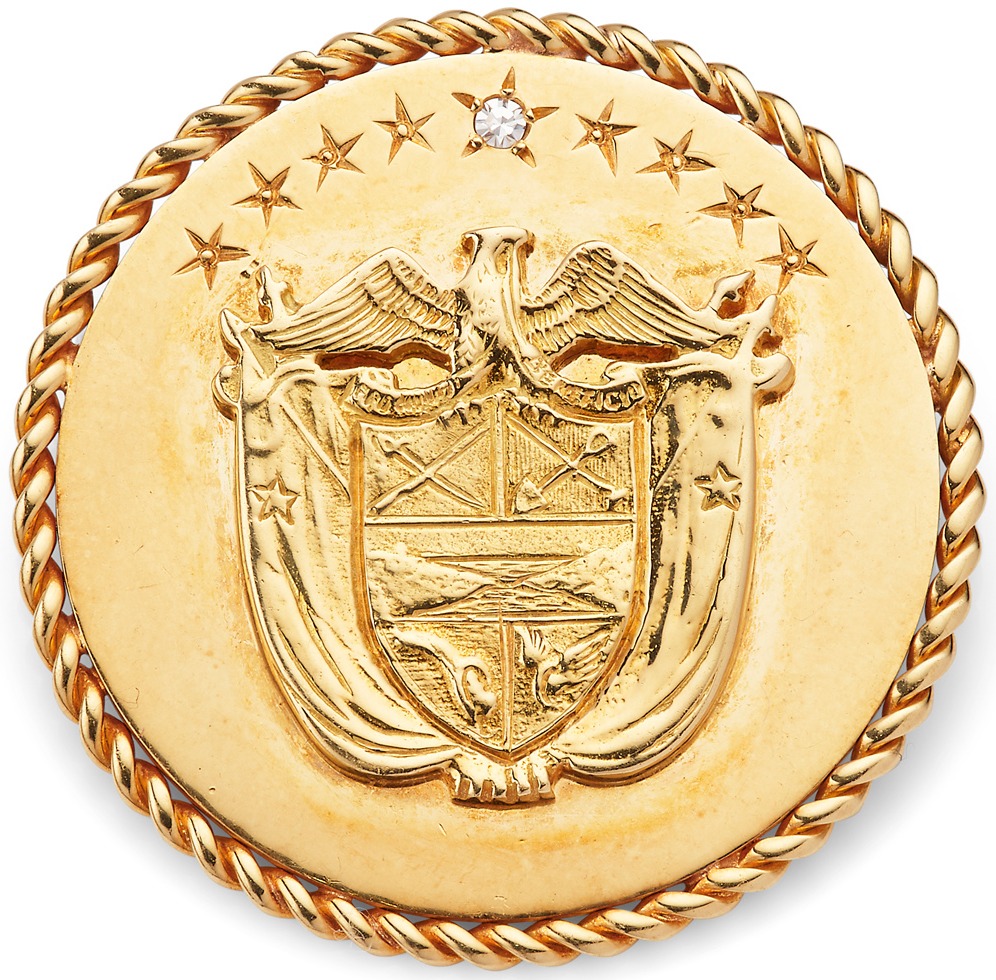
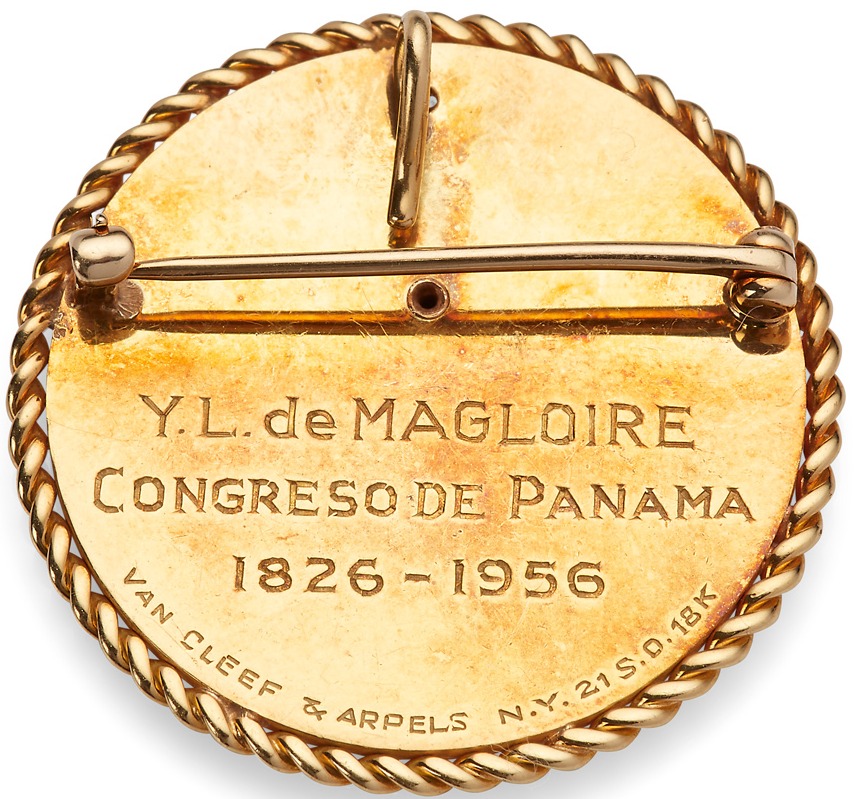
The new Haitian Government began improving relations with its neighbor - the Dominican Republic - which was at the time under the ruthless dictatorial rule of General Trujillo.
A policy statement from the U.S state department describes Trujillo:
"Trujillo feels a personal and ideological affinity with General Franco of Spain"
The statement continues...
"Trujillo... refers to all his enemies, Communists and non-Communists alike, as Communists....
...The Dominican Government has from time to time indicated its willingness to support the United States and the United Nations in anti-Communist measures."
At home, in the Caribbean and in Central America, US anti-communism was, of course, just getting started.
Non-intervention and silent acquiescence was no longer the policy.
The bombs that fell on Indochina from the 1950s-1970s, of course, had no way of knowing who was communist and who wasn't, as if it mattered.
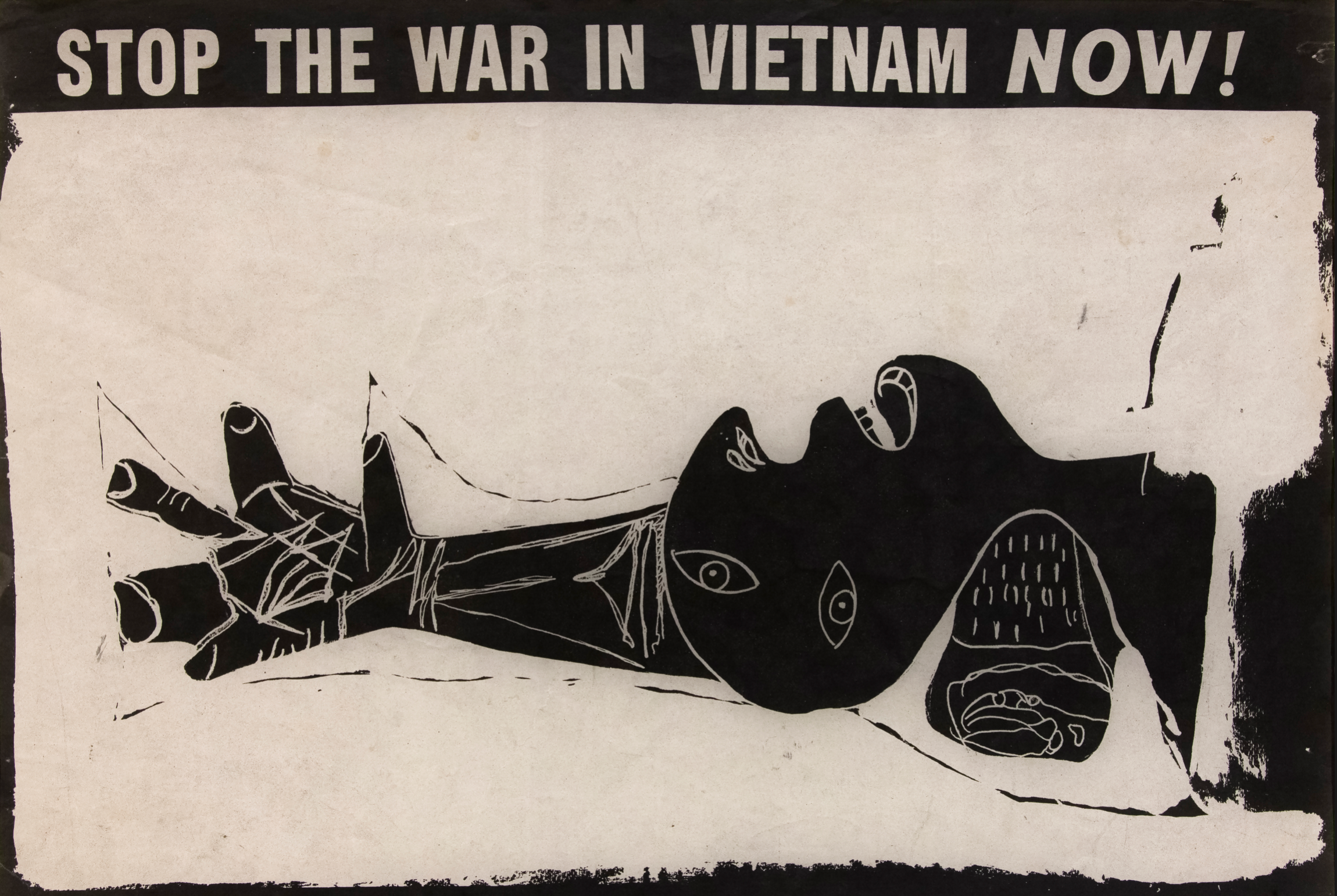
Rudolf Baranik, "Stop the war in Vietnam now!", 1967:
Picasso's Guernica was used in the United States by the anti-war movement
Laos remains the most bombed country in history, followed by Vietnam and Cambodia. In Laos, these bombs - as though they bore a “return to sender” - are now being made into jewellery and sold back to shoppers in the west.
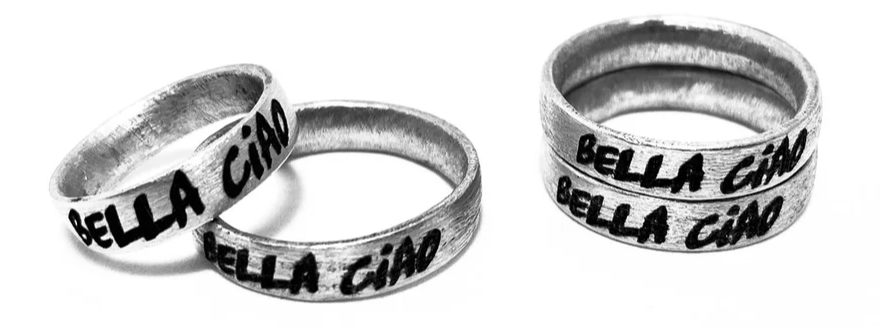
The No War Factory: "Bella Ciao" Ring - Reclaimed aluminium from wartime ordnance, handcrafted in Laos.
not shackle it.
This was never meant to be a fair fight, and it is not a fair fight.
We are punching them while they’re down,
which is exactly how it should be.”
- Pete Hegseth, Minister of War
March 4th 2026 during press briefing 4 days into the Iran War.
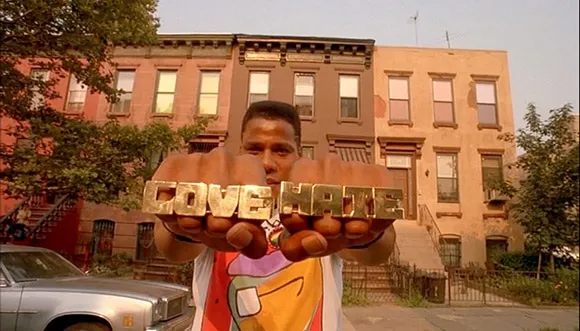
But maybe, just maybe, there is room for hope today.
Today, as solidarity and resistance jewellery comes back into fashion - more desirable and more outspoken than ever - it adorns the linked hands of a nascent international front, ever-more articulate and determined in its critique of injustice.
Gold and precious metals are among the earth’s most recycled materials.
Inscriptions of hope and resistance in the face of unchecked power have been washed from the surface of jewellery for centuries.
It is not difficult to find jewellery of resistance because it never existed - this series of articles has demonstrated that.
It is difficult to find jewellery of resistance because it has been recycled and rebranded by those who took the precious metals from the hands of those who opposed them.
I recall from both Francoist Spain and Mussolini's Italy, the "Gold for the Fatherland" initiatives. Franco froze republican assets, and devalued the republican-era currency to zero.
This "Law of Political Responsibilities" involved the following punishments for surviving Spanish Republicans:
"imprisonment (maximum: 15 years), the total or partial seizure of property, fines, the loss of civil rights, exile, and relegation (exile) to Spain’s African possessions."
Franco then created a "National Laboratory of Gold" ...
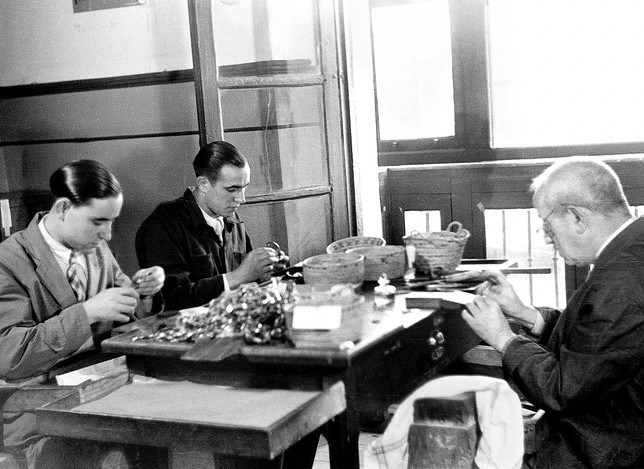
Civil Servants of the National Laboratory of Gold selecting jewellery and coins for melting to ingots. Published by "El Diario de Burgos", 15 de marzo de 2015
Lost Owl’s Modern Posy rings - together with this perhaps first-of-its-kind effort at a history of solidarity and resistance jewelry - are mere ripples in what this author hopes is a turning of the tide.
But the tide is turning. We know it is. We must help it do so.
And as it does, we might find our own jewellery of solidarity and resistance.
A friend recently told me that there is no such thing as a historian of contemporary history. She said that if one watches and writes about history as it unfolds then one is a journalist. We should leave this story be for the time being then - before it becomes journalism.
I do wonder, though, to what extent will these modern posy rings feature in a future historian's research on Solidarity and Resistance Jewellery...
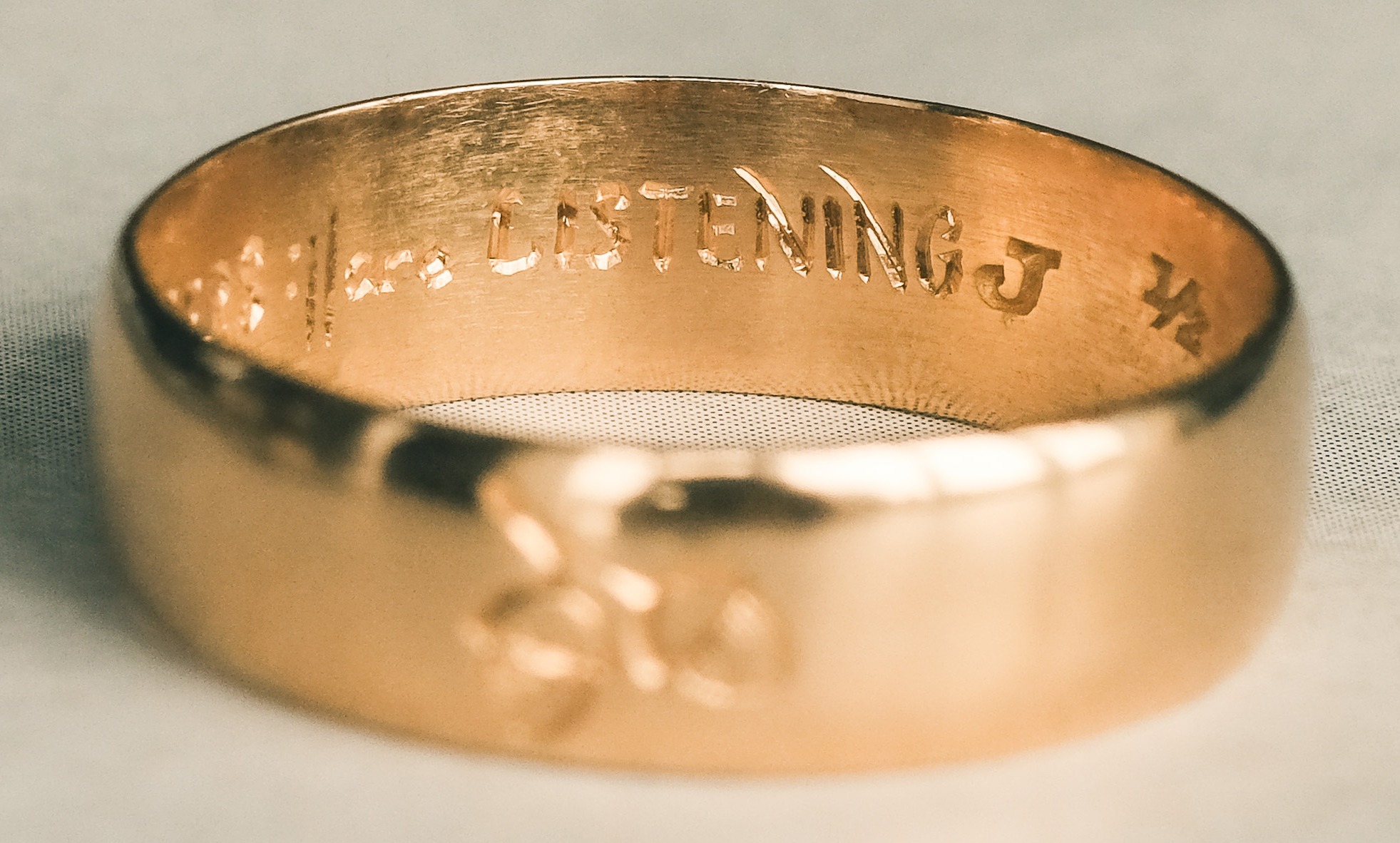
A Modern Posy Ring by LOST OWL:
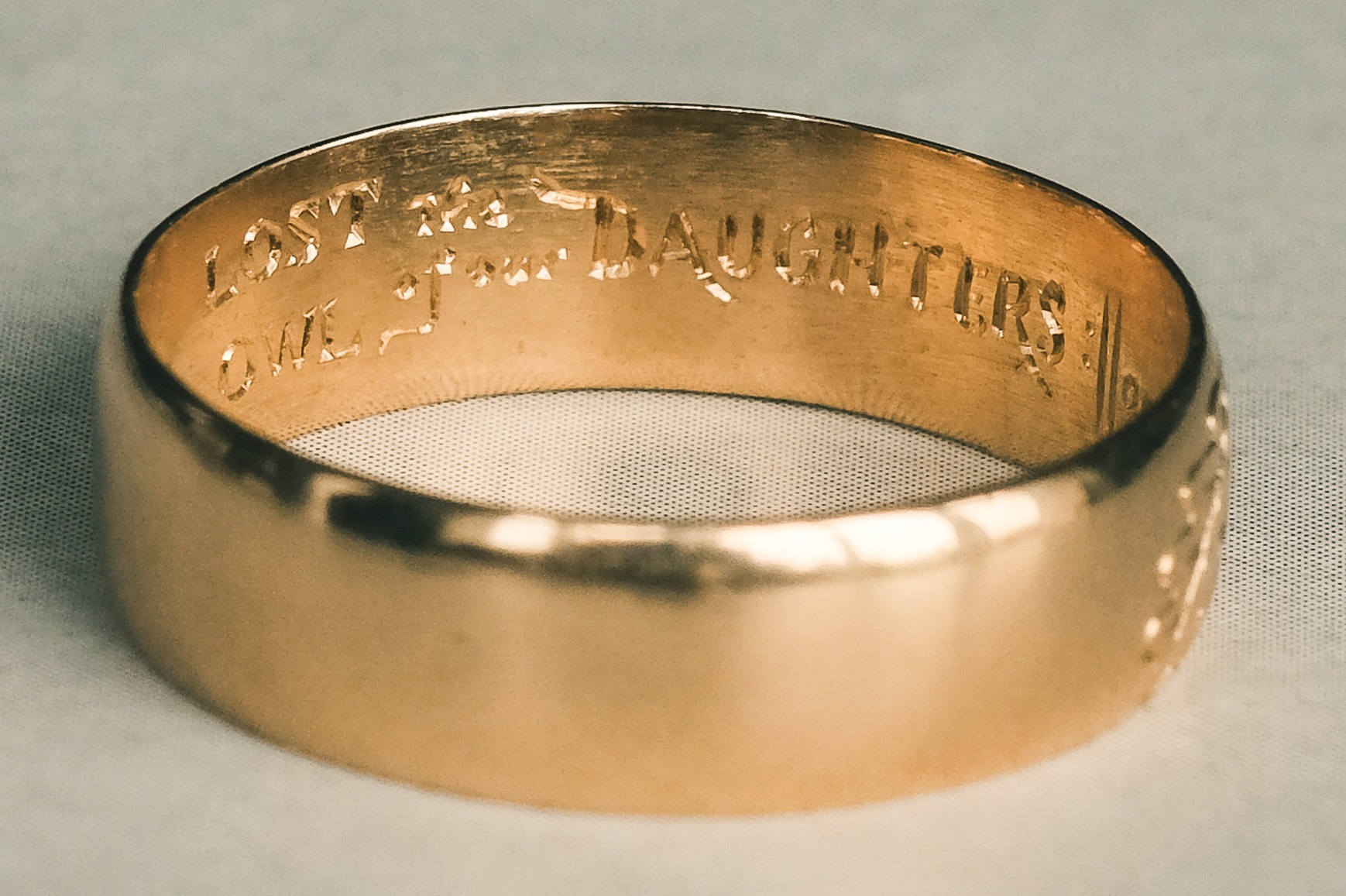
...are listening."
Bibliography
Unamuno, Bilbao, and Pre-Civil-War Spain
- Unamuno, Miguel de. Peace in War. Translated by Anthony Kerrigan, Princeton University Press, 1983.
-
While at War. Directed by Alejandro Amenábar, Mod Producciones / Movistar+ / Himenóptero, 2019
The Popular Front and the National Front in Spain
- El Palace Barcelona ; "Our heritage Our past, present and future"
- Graham, Helen. The Spanish Civil War: A Very Short Introduction. Oxford: Oxford University Press, 2005.
- Hogan, Deirdre. Industrial Collectivization During the Spanish Revolution from Red & Black Revolution (no 7, Winter 2003)
- Kasımoğlu, Zeynep Susem. "“Strong We Make Each Other”: Emma Goldman, The American Aide to Mujeres Libres During the Spanish Civil War, 1936-1939." Master's thesis, Bilkent University, 2017. Bilkent University Institutional Repository.
- Panseri, Francesca; "Peggy's Circle of Friends: Emma Goldman", Peggy Guggenheim Collection (online)
- Wedemeyer, Catarina von . "Talking about a Revolution: Federica Montseny and Emma Goldman during the Spanish Civil War“, in: Susanne Zepp, Raanan Rein (Eds.): Untold Stories of the Spanish Civil War. London: Routledge; Chapter 11, pp. 205-225.
The Spanish Civil War
- Knox, Bernard; The Confessions of a ‘Premature Anti-Fascist’ July 15, 2001 12, published in L.A. Times (online)
- Nolan, C.J. (2011). World War II: German invasion of Poland (September 1–October 5, 1939). In The Encyclopedia of War, G. Martel (Ed.). https://doi.org/10.1002/9781444338232.wbeow705
- Goldman, Emma; Address to the International Working Men’s Association Congress, From Emma Goldman Papers, Manuscripts and Archives Division, The New York Public Library, Astor, Lenox and Tilden Foundations (online)
Conclusion
- FOREIGN RELATIONS OF THE UNITED STATES, 1951, THE UNITED NATIONS; THE WESTERN HEMISPHERE, VOLUME II, Dominican Republic (online)
- International Commission of Jurists. 1962. Spain and the Rule of Law. Geneva: International Commission of Jurists. https://www.icj.org/wp-content/uploads/1962/12/Spain-rule-of-law-publications-1962-eng.pdf.
- Luz de Prado Herrera, María ; "Oro para la Patria". Confiscaciones, ‘donaciones’ y presión fiscal en los inicios del Franquismo. February 12, 2019 (online)
- Pauli, Lori; MARGARET DE PATTA: SHAPING LIGHT AND SPACE Published in Magazine on April 26, 2023, National Museum of Canada
- Mattei, Clara E.; THE CAPITAL ORDER How Economists Invented Austerity and Paved the Way to Fascism, The University of Chicago Press, Ltd., London, 2022
About the Author
Daniel is a language expert and hispanophile who, through his work with heritage professionals in Spain - his adopted home - , has developed an unexpected interest in all things history-adjacent.
His collaboration with Lost Owl is an endeavour to pursue the many half-written or incomplete stories in the history of jewellery. In this capacity, he turns his attention to the stately-yet-weather-beaten garden path of art history, caringly and tentatively turning over its many loose cobblestones and hoping to capture and share in writing the great craftsmanship and the stranger-than-fiction vicissitudes that the historic-landscaper repeatedly bears witness to.
But now as he writes and as ever, he must be true to his daily passions - the pot on the stove which requires his attention, and his electronic music which will - much to his perpetual frustration - not produce itself.