

TURQUOISE
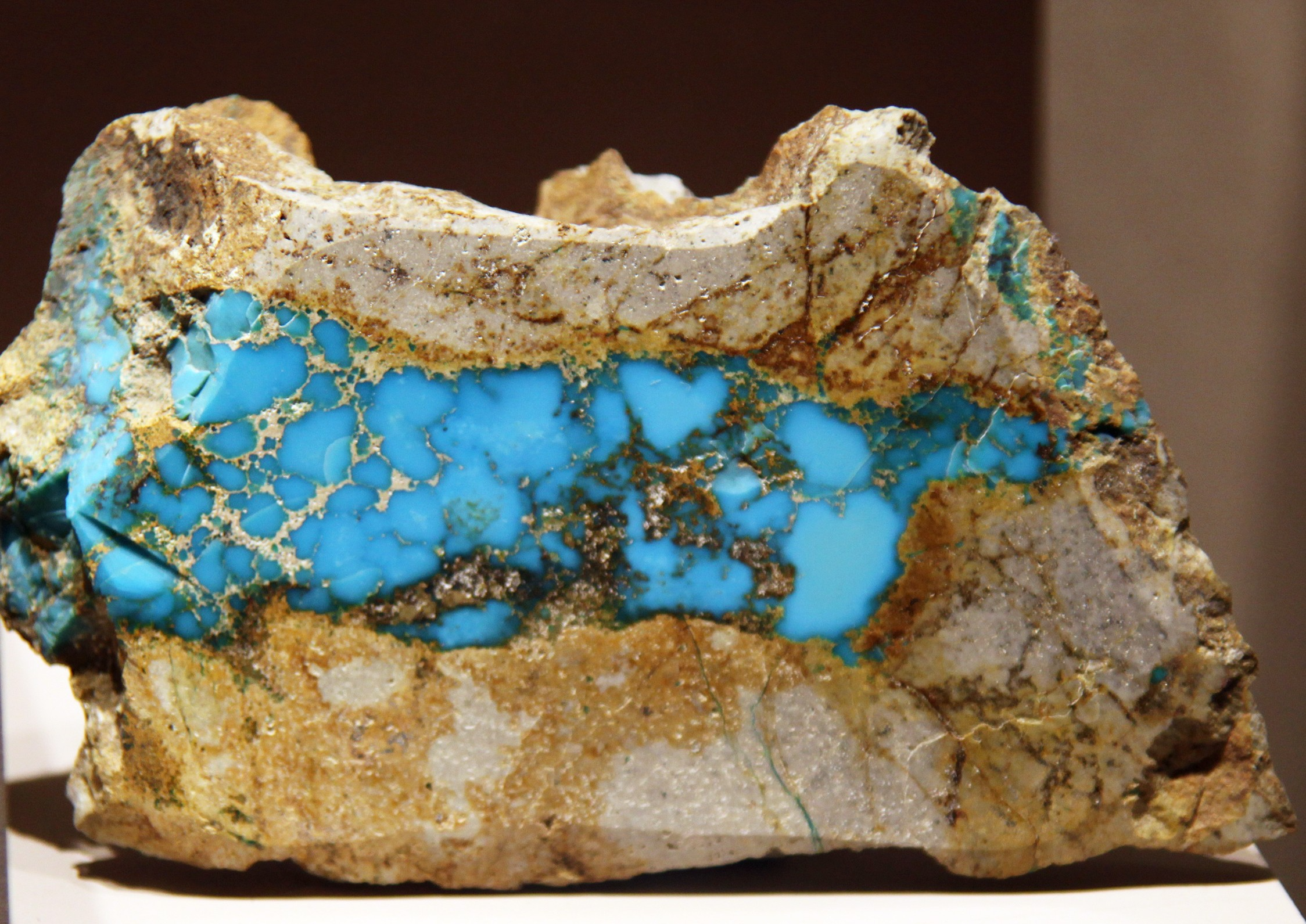
Turquoise from Cerillos, NM at the Smithsonian mineral collxn. [Photo: Tim Evanson]
Turquoise. The "Turkish Stone". The Victorians wanted them vivid and pure. The Arts and Crafters loved them with matrix; rough and ready. The Ottomans used them as diplomatic currency and the Romans knew them as callais. Rather unusual in many ways, this gemstone has variously acted as talisman and amulet, a stone of victory and a stone of delight, and now turquoise acts as the December birthstone. But... few gemstones carry a name born so entirely of a misunderstanding. When Venetian merchants first brought this opaque blue-green gem into Europe, via the Ottoman Empire, they assumed - wrongly - that it had come from Turkey. And thus its modern name, turquoise, from Old French turquoise meaning "Turkish," is a misnomer. In fact, its source lay deep in Persia (modern day Iran) but the name stuck, and "turquoise," the stone of Turkey, has endured ever since. But not only has it endured, it has evolved: the first recorded use of "turquoise" as a colour name in English was in 1573; perhaps this was a natural evolution, since turquoise (the gemstone) is all about the colour.
A Stone of Joy; A Stone of Victory
The ancient Egyptians, meanwhile, called it mefkat: "joy" or "delight." Turquoise jewellery has been found in Egyptian tombs dating back to 3000 BCE, indeed the funeral mask of Tutankhamun himself is famously inlaid with the stone (alongside lapis lazuli, carnelian, obsidian and glass paste). It was mined in the Sinai Peninsula, at sites near a temple dedicated to Hathor, the goddess of love and protector of miners in the desert.
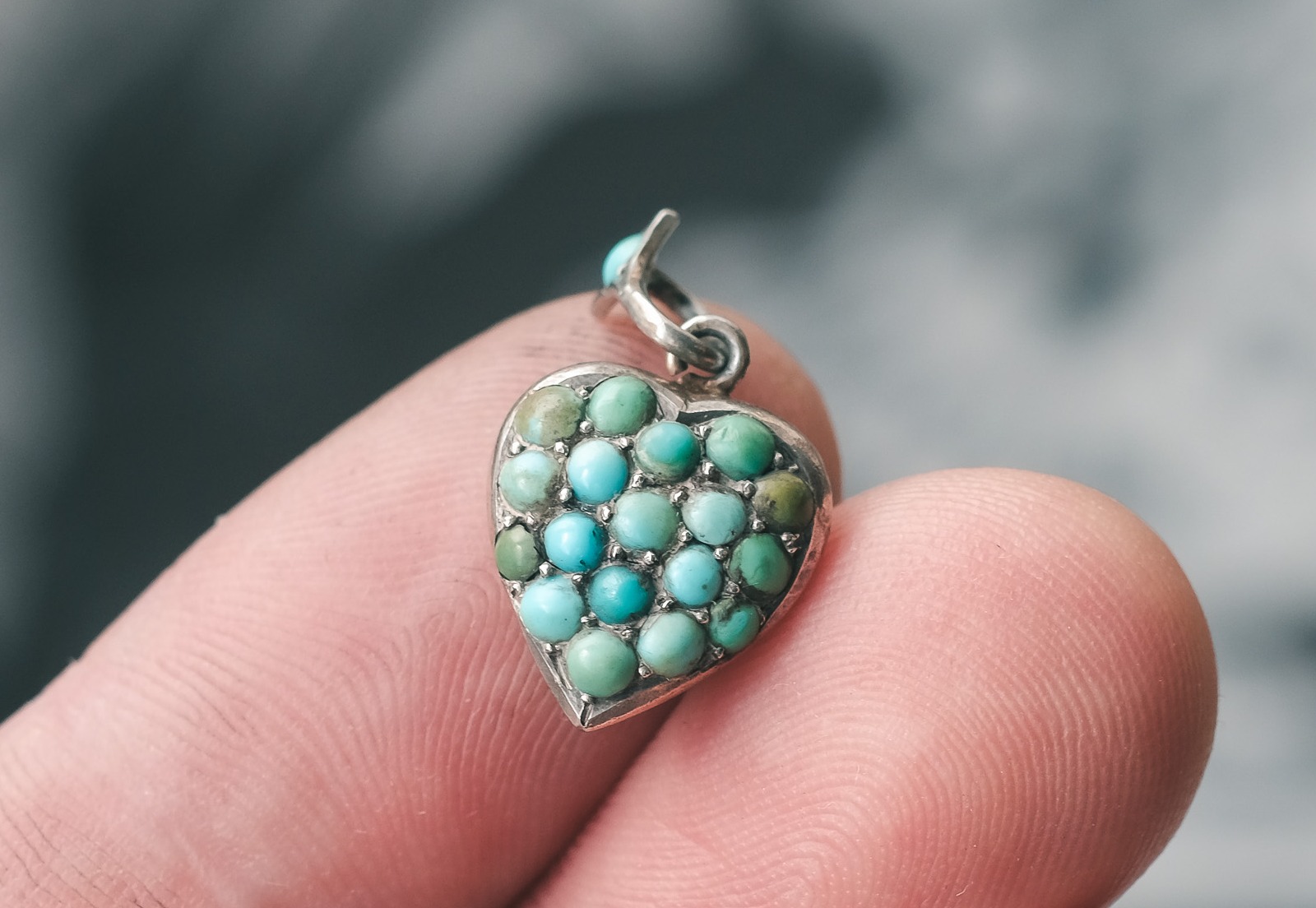
Lost Owl Archive: Victorian Pavé Turquoise Heart Pendant showing natural colour variations developed over time
That Sacred Blue that Crosses Continents
That turquoise held divine powers was a belief that extended far beyond Egypt and Persia. In Mesoamerica, the Aztecs called it chalchihuitl, a word for "precious stone" more broadly, and considered it currency fit for the gods - Montezuma is said to have gifted Hernán Cortés a turquoise mosaic shield, believing him to be the deity Quetzalcoatl. And across the American Southwest, in Navajo tradition, the stone carries deep associations with sky and rain. The Apache name for turquoise is duklij, which means both blue and green, and they believed it to be a thunder-stone that you could find by following a rainbow to its end after a storm, and that by attaching a piece of turquoise to a bow or gun would improve a hunter's aim. The Hopi thought lizards running over the earth made it; the Pueblo that its colour was borrowed from the midday sky. And in Tibet, on the opposite side of the Earth, turquoise was so revered it was considered more valuable than gold. In India, Hindu mystics held that seeing a turquoise just after the new moon promised wealth.
Then on to Europe and England, where turquoise was long regarded as a "stone of friendship." In Shakespeare's The Merchant of Venice, Shylock is told that his runaway daughter swapped a ring for a monkey. He replies: "It was my turquoise; I had it of Leah when I was a bachelor." He adds that he would not have given it up "for a wilderness of monkeys." But why did turquoise become associated with friendship? We can trace that, too, back to western Asia and an old Arabic proverb: "A turquoise given by a loving hand carries with it happiness and good fortune." The proverb is mentioned by George Frederick Kunz, famously employed as a gemmologist by Tiffany & Co., in his remarkable book The Curious Lore of Precious Gems (1913):
According to a wide-spread superstition, the talismanic power of a diamond was lost if the stone were acquired by purchase; only when received as a gift could its virtues be depended on. The same belief is noted regarding the turquoise. The spirit dwelling in the stone was thought to take offence at the idea of being bought and sold, and was supposed to depart from the stone, leaving it nothing more than a bit of senseless matter. If, however, the diamond (or turquoise) were offered as a pledge of love or friendship, the spirit was quite willing to transfer its good offices from one owner to another.
Kunz elaborates further with an anecdote from the 16th century court of Holy Roman Emperor Rudolph II:
Anselmus de Boot, court physician of Emperor Rudolph II, tells a story of a turquoise that, after being thirty years in the possession of a Spaniard, was offered110 for sale with the rest of the owner’s property. Every one was amazed to find it had entirely lost its color; nevertheless De Boot’s father bought it for a trifling sum. On his return home, however, ashamed to wear so mean-looking a gem, he gave it to his son, saying, “Son, as the virtues of the turquoise are said to exist only when the stone has been given, I will try its efficacy by bestowing it upon thee.” Little appreciating the gift, the recipient had his arms engraved on it as though it had been only a common agate and wore it as a signet. He had scarcely worn it a month, however, before it resumed its pristine beauty and daily seemed to increase in splendor.
Indeed, Kunz has much to say of turquoise in European folklore, and takes care to note the belief that it could protect against falling off horses or walls:
Not long after, the powers of De Boot’s turquoise were put to the test. As he was returning to Bohemia from Padua, where he had just taken his degree, he was forced to traverse a narrow and dangerous road at night. Suddenly his horse stumbled and threw him heavily to the ground, but, strange to say, neither horse nor rider was injured by the fall. Next morning, while washing his hands, De Boot remarked that about a quarter of his turquoise had broken away. Nevertheless the stone did not lose its virtue...
Science & Symbolism: The Stone that Blushes and Pales
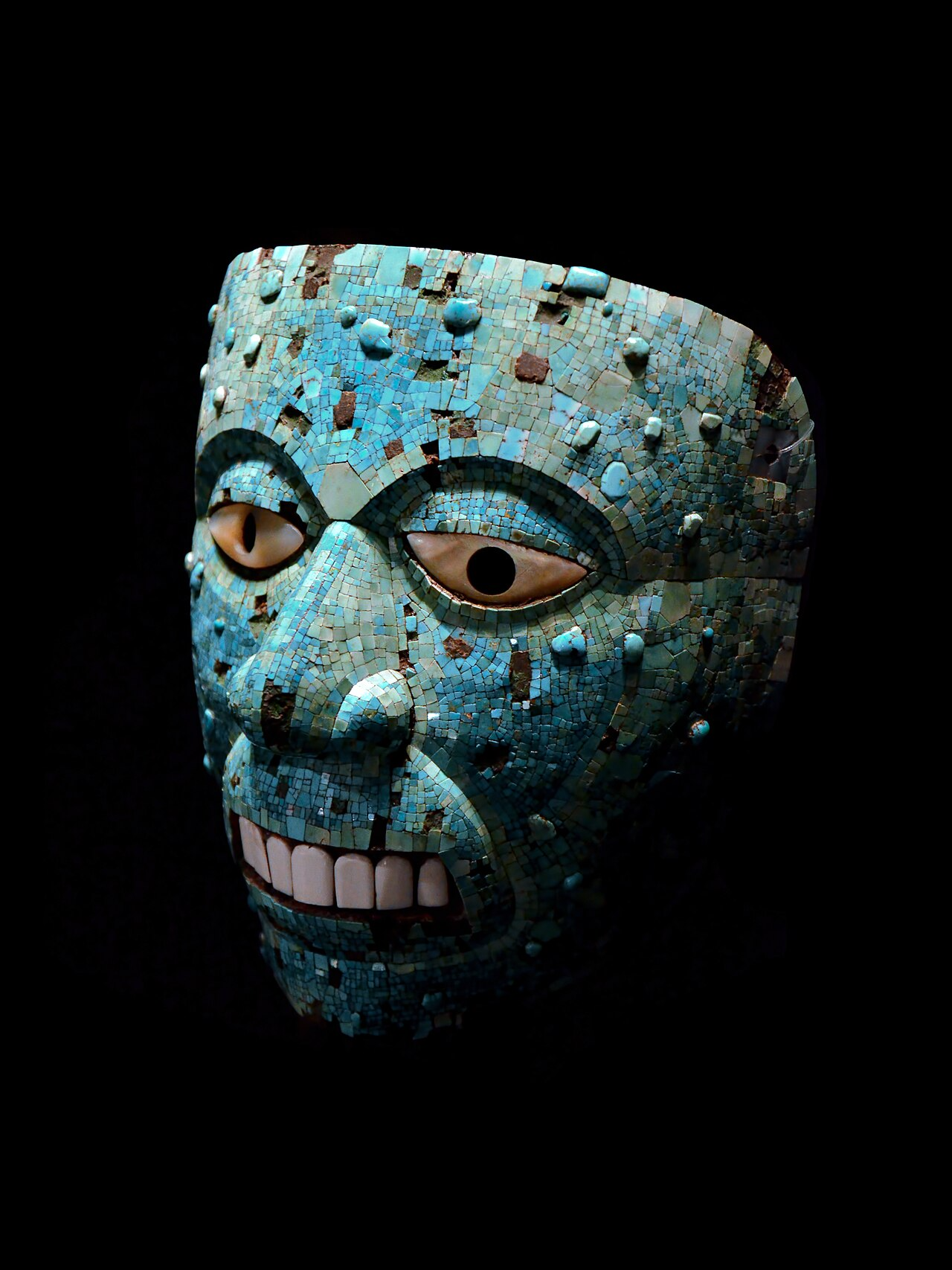
Turquoise mosaic mask of Xiuhtecuhtli, the Aztec god of fire.
The Specifics
Composition: Hydrous phosphate of copper and aluminium, CuAl₆(PO₄)₄(OH)₈·4H₂O
Crystal System: Triclinic
Lustre: Waxy to subvitreous
Inclusions: Rock matrix
Refractive Index (RI): 1.61-1.65
Transparency: Opaque
Hardness: 5-6
Colour: Turquoise, blue, blue-green, green
Bibliography
Gemmological Association of Great Britain (Gem-A) — Various printed matter
George Frederick Kunz — "The Curious Lore of Precious Stones" (1913)
American Gem Society — "History of the Turquoise Gemstone" — https://www.americangemsociety.org/birthstones/december-birthstones/history-of-turquoise/
Cultural Elements — "Turkish Stone: The Ancient Lore of Turquoise" — https://www.culturalelements.com/blogs/tapestry/turkish-stone-the-ancient-lore-of-turquoise
Monica Vinader — "The Role of Turquoise in Ancient Egypt & Persia" — https://www.monicavinader.com/us/blog/gemstones/turquoise/ancient-egypt-and-persia
The Metropolitan Museum of Art — "Turquoise in Ancient Egypt" — https://www.metmuseum.org/essays/turquoise-in-ancient-egypt
GUILD Gem Lab — "Exploring the Origins of Gemstone Names: Language, Geography, and Human Stories" — https://www.guildgemlab.com/news/exploring-the-origins-of-gemstone-names-language-geography-and-human-stories/
TradeRoots Collection — "Turquoise Story" — https://traderoots.com/Turquoise/Turquoise_Story/
StudyGuides.com — "Turquoise (Gemstone) — Overview" — https://studyguides.com/study-methods/overview/cmmkfg83s9yli01aa9yd4eepb