

TOPAZ
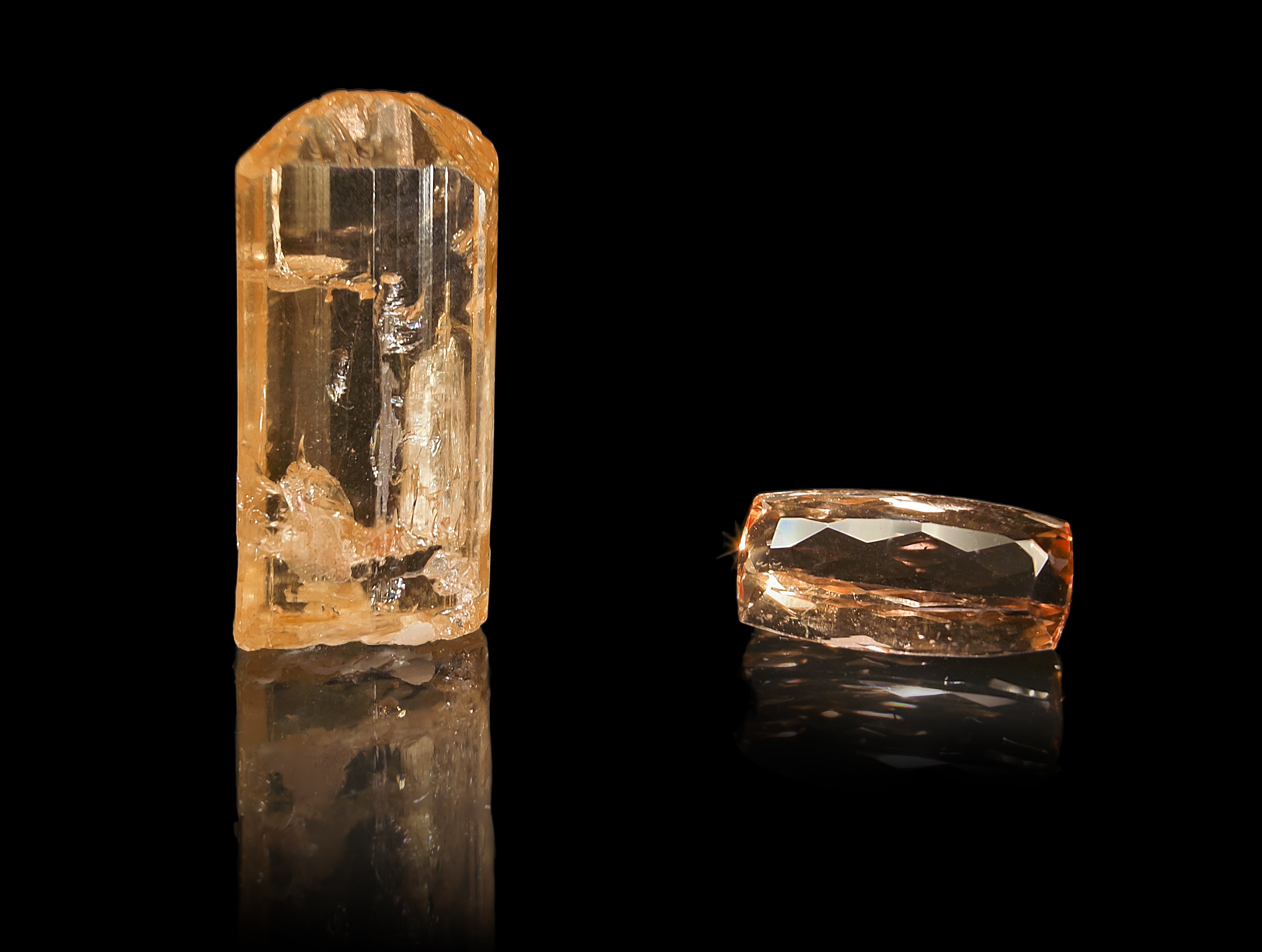
Imperial Topaz from the Minas Gerais region of Brazil.
The Facts
- Heat treatment - most pink topaz is obtained by heating yellow and brown stones which contain chromium. The yellow is removed by the heating process, leaving the residual pink colour caused by chromium.
- Irradiation - the irradiation of colourless topaz can produce yellow and brown stones, but these colours are not stable and can fade on exposure to light. Irradiation followed by heating can produce a range of more stable blue hues, which replicates the natural irradiation processes found in the state of Minas Gerais in Brazil.
- Coating - topaz can be coated to produce a wide range of colours and effects including green topaz and a rainbow-like iridescent effect referred to as ‘mystic topaz’. This coating is also referred to as diffusion treatment.
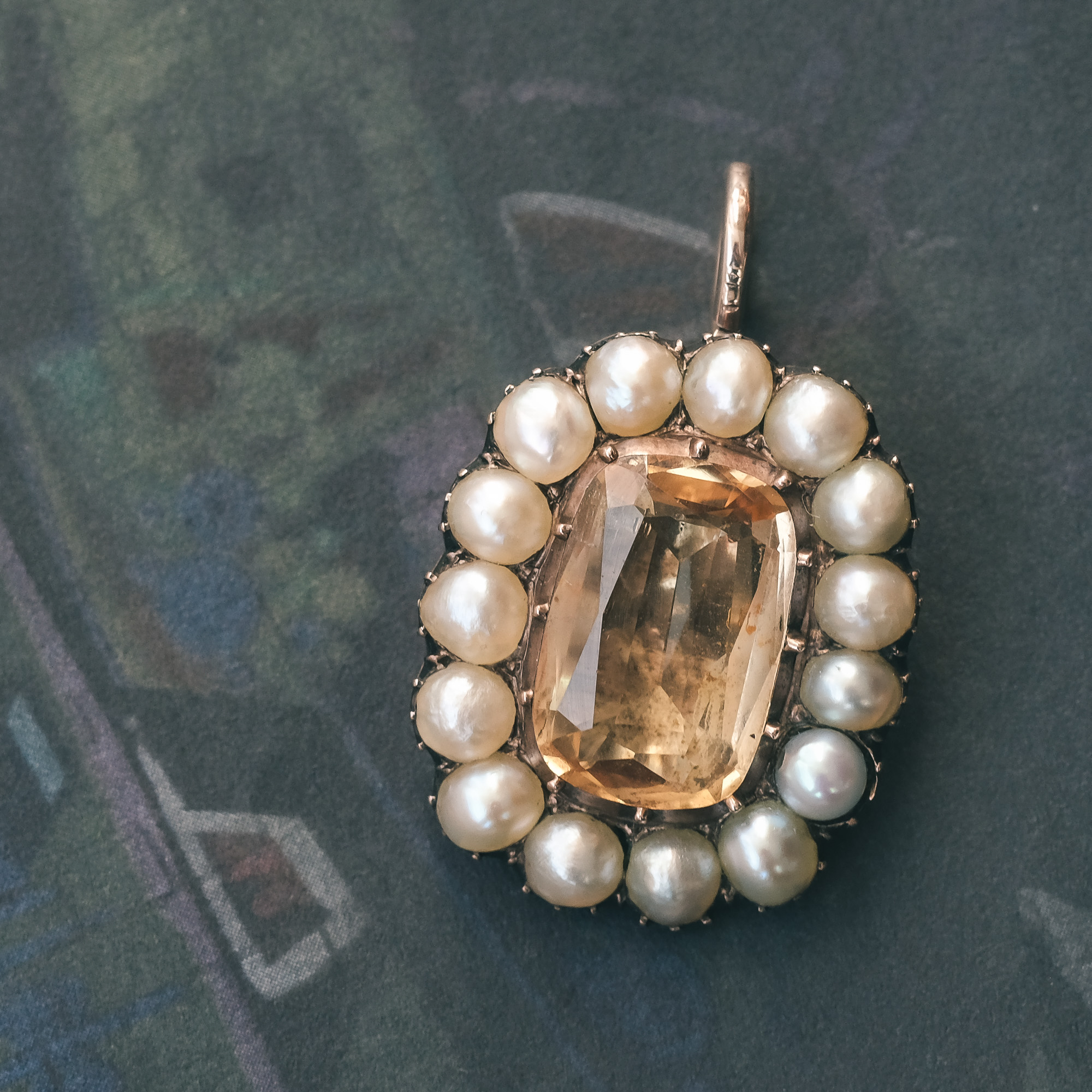
Natural topaz can also occur in wine red, grey, green, reddish-orange, and pink, but these natural examples are rare. A particularly special example of the gemstone, Imperial Topaz, is the most prized naturally hued variety and spans vibrant yellow to rich orange and golden brown colours, sometimes with pink and violet undertones. Brazilian imperial topaz mined in Minas Gerais is among the world’s finest. Topaz also displays pleochroism, meaning that different colours can be seen from different angles as you move the gem in the light due to its double refractive property. For example, red topaz may show dark reds, yellows, and pinkish red tones from various aspects. This pleochroic nature of the gemstone also means that the natural colours of imperial topaz effortlessly flow from bright yellow to orange and, occasionally, from orange to pink.
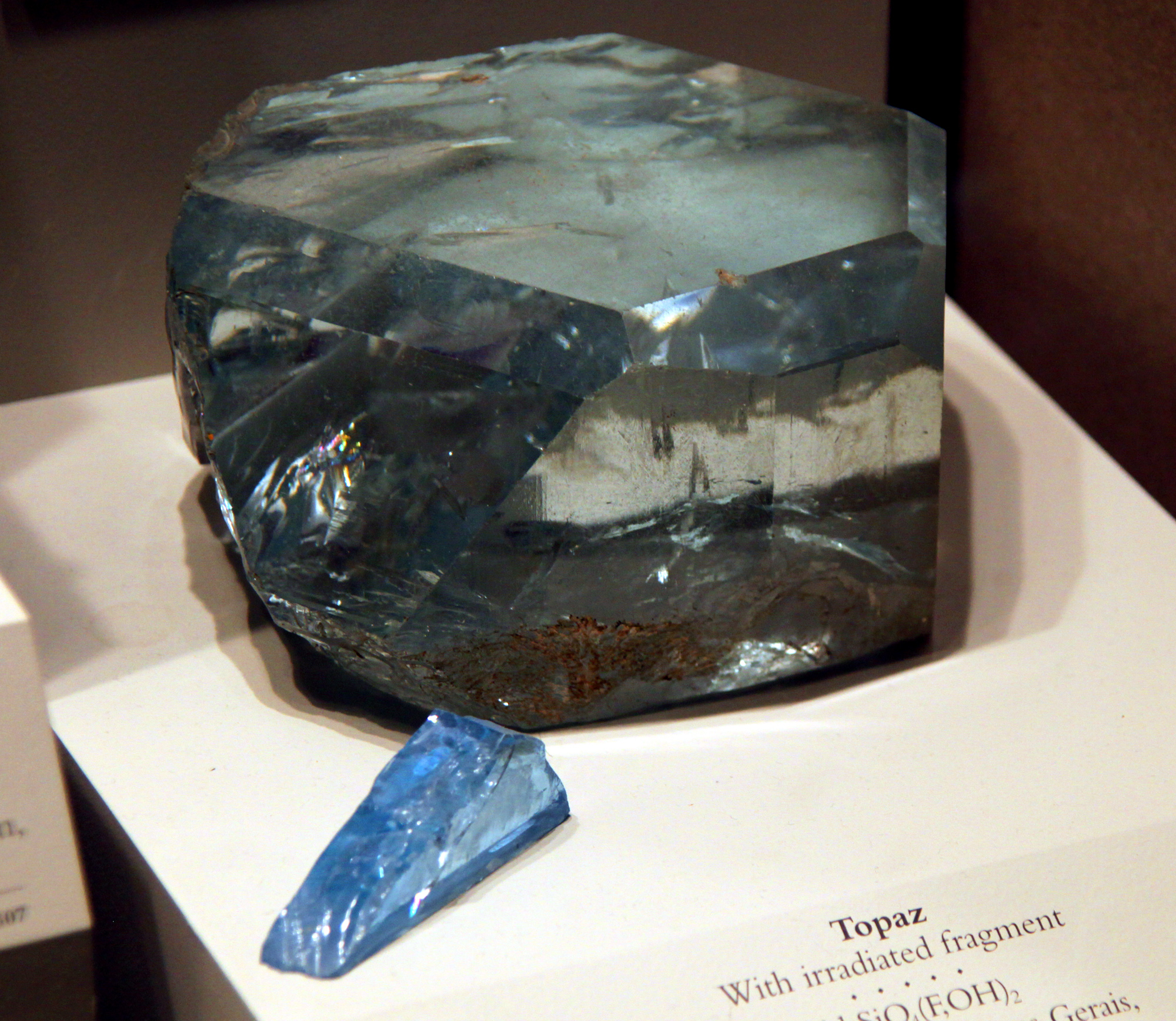
Topaz with a small irradiated fragment on display at the Smithsonian Museum of Natural History.
Topaz belongs to the second rank of gemstones, or semiprecious stones, along with aquamarine, morganite, and tourmaline (the first rank, known as the precious stones, is comprised of ruby, sapphire, diamond, and emerald), and it ranks among the hardest naturally occurring minerals. Only diamond and corundum, which includes ruby and sapphire, rank higher than topaz on the Mohs scale of hardness. However, it also has perfect cleavage, meaning it breaks along smooth, flat planes as a result of weak chemical bonds within its crystal structure. Consequently, despite its hardness, topaz can chip or split cleanly if struck at the wrong angle, meaning it requires careful handling by lapidaries.
Topaz commonly forms in silicic igneous rocks, particularly granite and rhyolite, crystallising in granite pegmatites or vapour cavities in rhyolite lava flows such as those found at Topaz Mountain in western Utah and Chivinar in South America. Although its history is much longer, topaz as we know it was first discovered and named in Germany in 1737, with deposits also being discovered in Brazil and Russia’s Ural Mountains around a similar time. Brazil is one of the largest producers of topaz, particularly the state of Minas Gerais where the gemstones are praised for their high quality. Some crystals from Brazilian pegmatites, such as the Braganza Topaz, have been known to reach boulder size and weigh hundreds of pounds. This particular example was unearthed in 1740 and initially believed to be a diamond, weighing a mighty 1,680 carats. Its size and splendour quickly saw it set into the Portuguese Crown Jewels where it remains till this day. Brazil is also known for producing the El-Dorado Topaz which is a 31,000 carat golden topaz that is recognised as the world’s largest faceted gemstone. It was discovered in 1984 in the Minas Gerais region and, originally weighing around 37kg, was cut into its final emerald shape weighing 6.2kg and is now part of the Spanish Programma Royale collections.
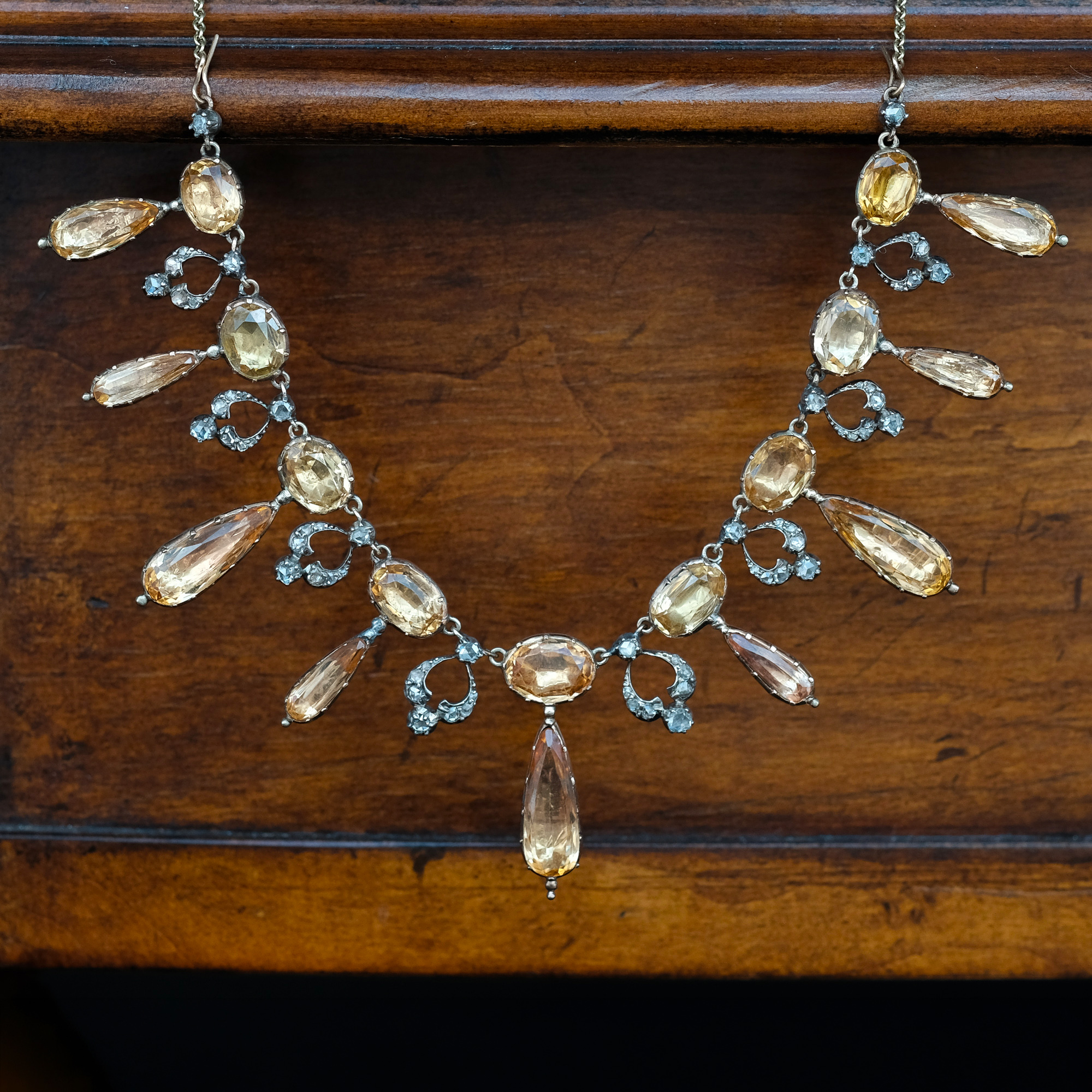
Georgian Imperial Topaz Necklace, Available Now.
Russia’s Ural Mountains have also been a leading source of topaz since the 19th century, and is particularly famed for producing the prized, high-quality Imperial Topaz. Northwestern Pakistan is also noted for producing pink topaz, with the small town of Katlang being mined since 1972. The most sought-after shade of pink topaz from Katlang has a violet tinge to it which is sometimes referred to as cyclamen pink. Other localities include Sri Lanka, Afghanistan, Mexico, Nigeria, Italy, Japan, and the United States, although it is much more rare in these areas.
The Legend
The word topaz is generally believed to have derived from the Greek Topázios, the ancient name for St. John’s Island in the Red Sea. Yellow gemstones were famously mined here in ancient times and, although now we know that this mineral was most likely chrysolite, topaz soon became the name used for most yellow stones. The name topaz was first applied to the gemstone we know today in 1737. Another possible origin of the name comes from the Sanskrit word Tapaz, meaning fire. This could be referring to either to gemstone fire - the way in which white light is split into a rainbow spectrum of colours within a gem - or the fact that topaz is often found in a beautiful deep golden colour.
Topaz has represented different things to different peoples and cultures for centuries. In ancient times, the Egyptians believed that topaz received its golden hue from the sun god Ra and offered supernatural powers of strength and protection. The Greeks also thought that topaz possessed protective qualities, even attributing it with the power to make the wearer invisible during times of danger, and the ancient Romans recognised this gemstone’s use for strength and believed it would guard and protect travellers.
During the Middle Ages, topaz was among Europe’s most enchanted stones, and was assigned with many different powers and healing properties. It was believed the stone could enhance mental powers and cure lunacy and, when worn on the left arm in particular, the stone was said to protect the owner from any curse and ward off the evil eye. Topaz was also entrusted with the power to break spells and quell anger, as well as prevent poisoning by changing colour when near food or drink that had been tampered with. And it was not just mental and spiritual matters that could be resolved by this gemstone, Topaz was also thought to be able to cure a variety of physical ailments, for example relieving arthritis pain, improving digestion, aiding weight loss, and healing a cold or fever by increasing body heat. The use of topaz to cure dimness of vision was also strongly recommended by St. Hildegard, a 12th century mystic. She directed that the stone should be soaked in wine for three days and three nights, after which it should be rubbed gently on the eyes to help improve sight. Carved topaz, in particular, was held in esteem during the Middle Ages as natural wonders possessing special powers as seen in Ragiel’s Book of Wings, where the image of a falcon on a topaz was thought to help acquire the goodwill of kings, princes, and magnates.
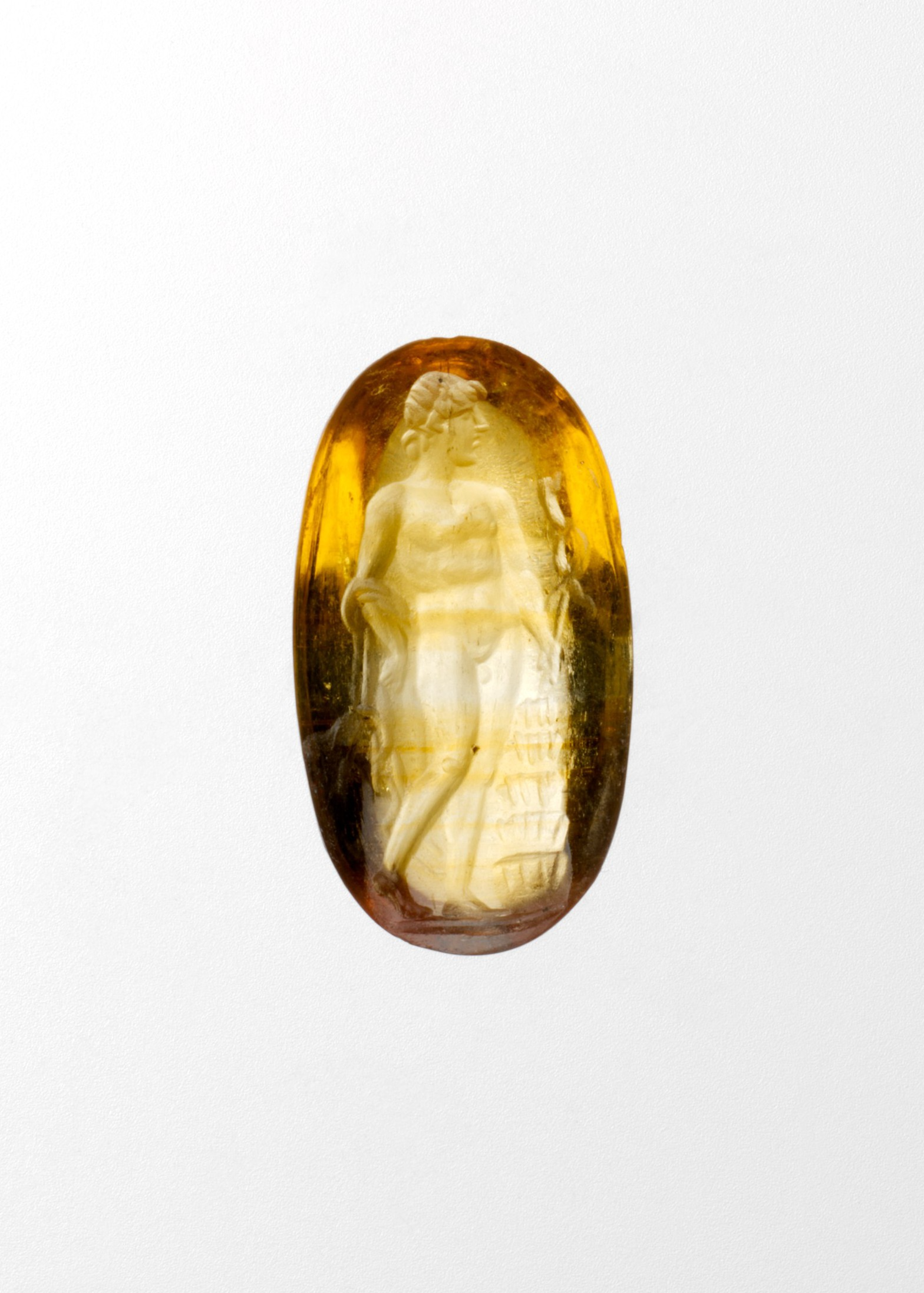
Roman Carved Topaz Stone, 1st Century BCE - 3rd Century CE.
Topaz is also a gemstone rooted in religious lore, holding a particularly special place in Hindu and Christian traditions. Hindus have deemed topaz sacred for centuries and in India it has long been associated with beauty, intelligence, and a long life if worn above the heart. The gemstone appears in Christian teachings too, where it is described in the book of Revelation as one of the foundation stones of the New Jerusalem. These stones were also assigned to each of the twelve Apostles, although in differing accounts the same stone was not always ascribed to a given Apostle. According to Andrea, Bishop of Caesarea, of the 10th Century, topaz’s curative powers in relation to sight ‘seems to denote Matthew, for he was animated by a divine zeal, and… he was found worthy to enlighten by his Gospel those whose heart was blinded, that they might like new-born children drink of the milk of the faith.’ Some theologians have opposed this assignment of the foundation stones to the Apostles as they held that only Christ himself could be regarded as the foundation of the Church, so the symbolism of these stones should be reserved for Christ alone. In this reading, topaz was said to represent His uprightness.
In modern times, different varieties of topaz are said to hold different symbolic meanings. Blue topaz represents clarity and communication; yellow is associated with abundance, confidence and joy; pink symbolises love and hope, and is believed to enhance emotional bonds; green and purple varieties represent healing and intuition; and imperial topaz is linked to creativity and strength. This highly sought-after variety of the gemstone is also strongly associated with royalty, likely as a result of the way in which its ownership was restricted to the Russian royal family after it was discovered in the 19th century. And as the November birthstone, yellow topaz is thought to bring strength, protection, and wisdom to those born in this month.
Topaz is a stone whose story crosses geology, myth, opulence, and imagination. Whether prized for its brilliance or admired for its supposed powers, topaz continues to captivate collectors, storytellers, and wearers alike and, I am sure, will continue to do so for generations.
‘Whenever you touch a Topaz, it touches you. It awakens a gentle fire, like wine awakens in grapes.’ - Pablo Neruda
The Specifics
Composition: Fluorosilicate of aluminium with hydroxyl, Al₂SiO₄(F,OH)₂
Crystal System: Orthorhombic
Lustre: Vitreous
Colour: Red, pink, orange, yellow, brown, blue, green, and colourless
Inclusions: Tube-like cavities, healed fractures and incipient cleavages
Refractive Index (RI): 1.61 to 1.64
Transparency: Transparent to transluscent
Hardness: 8