

GARNET
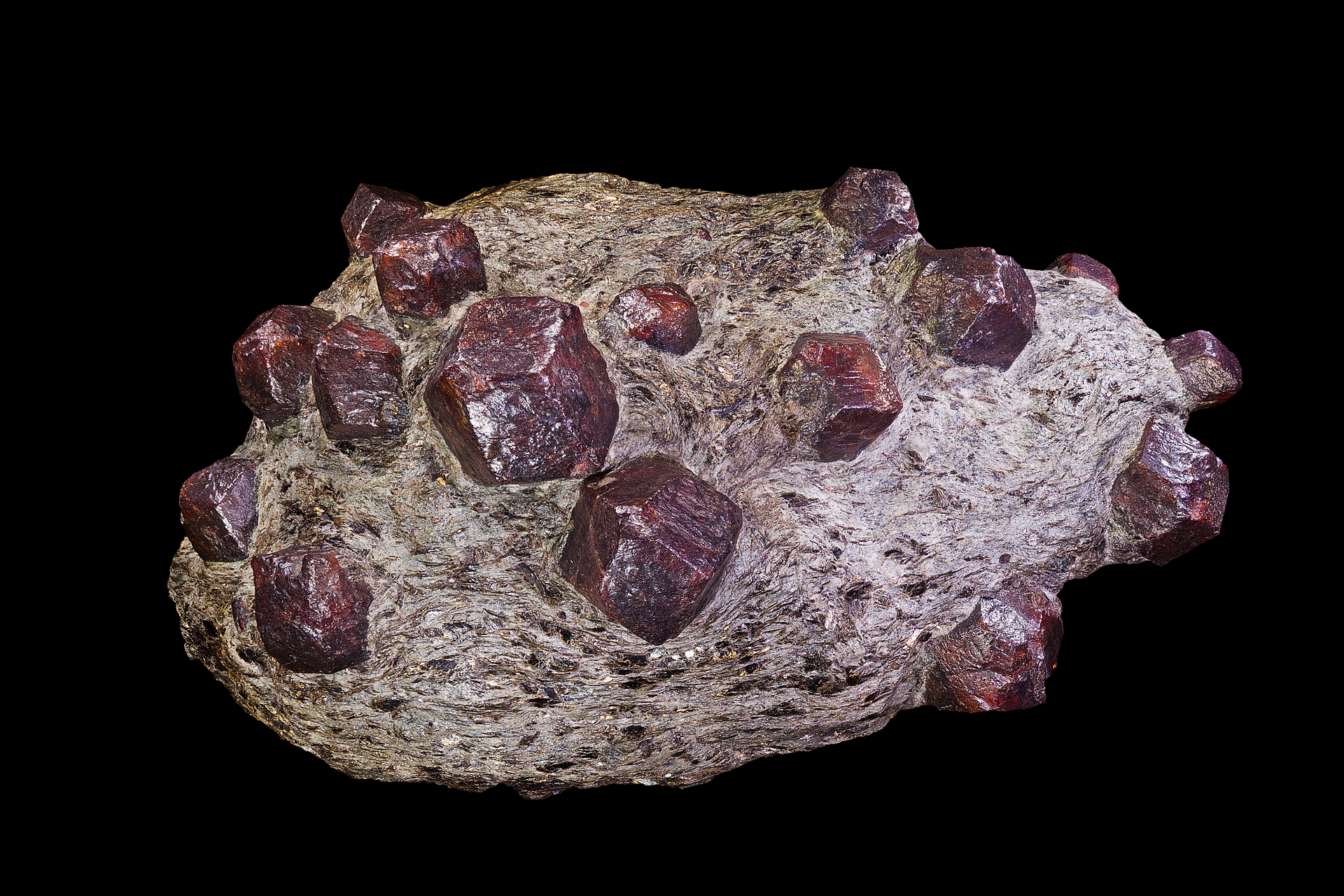
Almandine Garnet on a metamorphic schist, from Austria's Gaisberg Valley.
The Facts
- Almandine garnets which typically display shades of brownish to purplish red are made up of iron, aluminium and silicon.
- The pink to orange-red of pyrope garnets are caused by a mixture of magnesium, aluminium and silicon.
- The andradite variety, with shades of green, yellow-green, golden yellow or brown, contains calcium, iron and silicon.
- Grossular garnets range from pale to rich green and even yellow, brown or pink and are made up of calcium, aluminium and silicon.
- The warm yellow, orange, and reddish-brown hues of spessartine are caused by manganese, aluminium and silicon.
Almost all garnets are a blend of these five species; rhodolite, for example, which displays a beautiful purplish-red colour, is a mix of pyrope and almandine, and light green to yellow-brown mali garnets which are a blend of grossular and andradite.
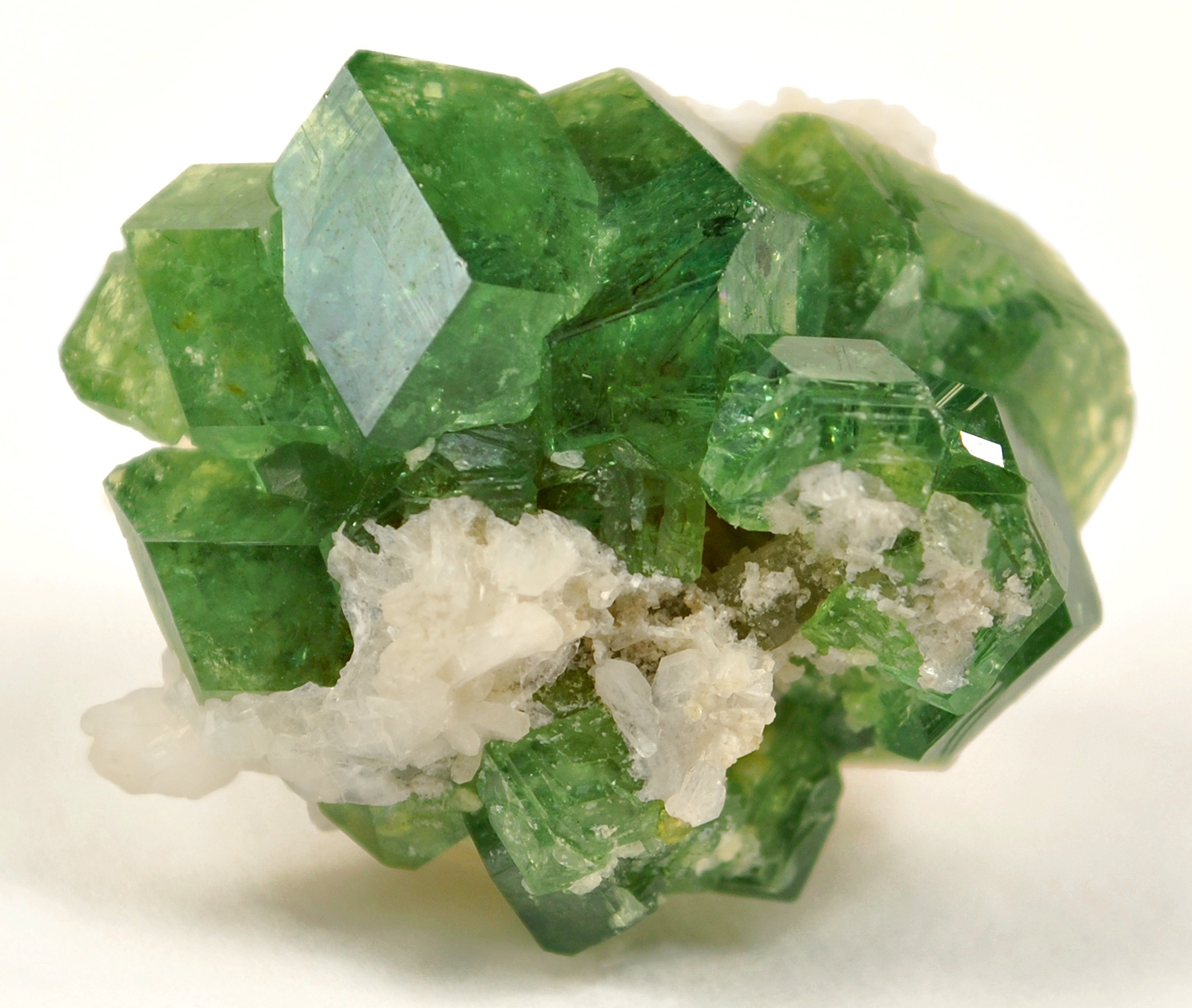
Demantoid Garnet from the Ambanja District of Northern Madagascar.
The reason that garnet was thought to be only a red gemstone for so many years was due to its sheer abundance, with iron being so much more common in the earth than these other elements. However, the more recently discovered green branches of the garnet family are among the rarest and most prized of their kind with hues that can rival or exceed that of fine emeralds. Discovered in Russia’s Ural Mountains in the mid nineteenth century, demantoid garnet exhibits a vivid but deep grassy green colour with the remarkable ability to refract and disperse, scattering white light into a blazing rainbow in a way never seen before in a coloured gem. This sparkle and fire led to them being named demantoid, meaning ‘diamond-like’. The striking appearance and provenance of these garnets made them an obvious choice for the Tsars of Imperial Russia and their court jeweller, Carl Faberge. Faberge’s highly elaborate and intricate work made use of demantoids, most notably featuring in the ‘Winter Egg’, part of the series of Imperial Eggs that would come to define the Faberge name.
A second discovery of green garnets came from Kenya in the 1960s by Scottish geologist Campbell Bridges. The tsavorite variety, described as ‘intrinsically superior to emerald’, boasts a cleaner colour that requires no treatment, as well as being less brittle, more brilliant and dispersive of light, and demonstrating a greater clarity. Bridges called tsavorite garnets the Rolls-Royce of green gemstones. However, while tsavorite may be preferable in many ways to emerald, it is also around 1,000 times rarer which, despite adding to its charm, also acts as a further barrier to any aspiration to unseat the traditional green gem from its throne.
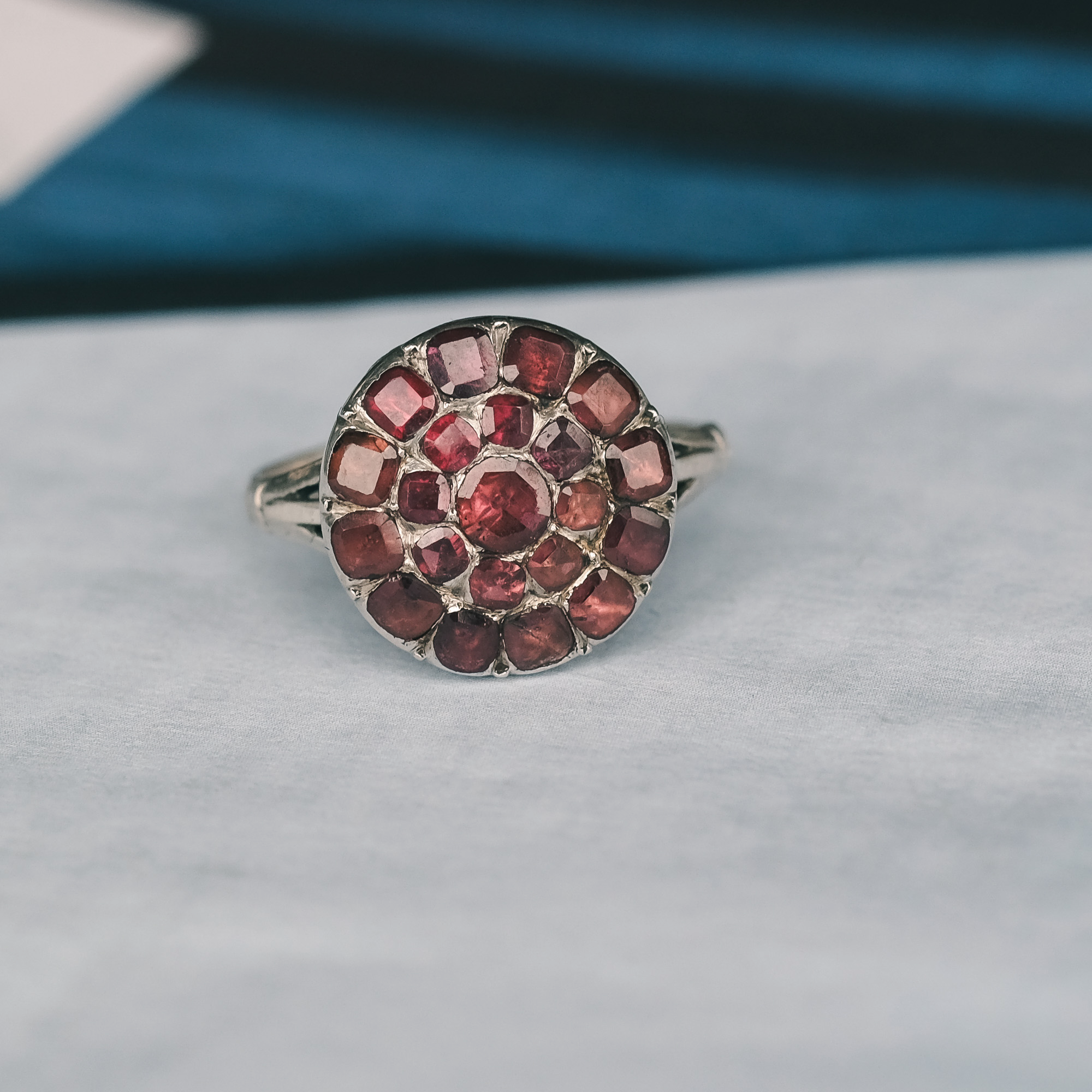
Georgian Garnet Ring, available now.
Garnets are most commonly found in metamorphic rocks and, to a lesser extent, in igneous rocks around the world, typically forming under high temperatures and pressures deep within the Earth. For example, almandine commonly develops in metamorphic rocks such as mica schists, where it is associated with minerals like staurolite, kyanite, and andalusite. The pyrope variety is an indicator of high-pressure conditions and is found in mantle-derived rocks such as peridotites and eclogites. Most natural garnets are compositionally zoned and contain inclusions, resulting from the changing conditions during their growth. These gemstones are found all over the globe, with major deposits in Austria, Afghanistan, Brazil, India, Sri Lanka, and the Czech Republic. Significant sources today include India, Kenya, Mozambique, Tanzania, Madagascar, and the United States. The open-pit Barton Garnet Mine at Gore Mountain in the Adirondack Mountains is famed for producing some of the world’s largest garnet crystals, with diameters ranging from 5 to 35cm and commonly averaging 10 to 18cm. Bohemia in the Czech Republic also has a rich history of garnet mining, celebrated for producing intense, deep-red pyrope crystals. Though production has declined in recent times, it remains renowned for processing and crafting high quality garnet jewellery.
The Legend
The garnet appears to have multiple sources vying to take credit for the origins of its name, however in ancient times it was called something else entirely. Historically, red gemstones that have since been separated into different species and groups - like rubies, spinels, and garnets - by modern gemologists were often considered to be the same type of stone. The Romans, and most notably Pliny the Younger, used the term ‘carbunculus’, and the Greeks ‘anthrax’, both referring to the burnt coals and glowing embers which the red stones resembled.
“The Garnet is a red gem, but not like the Ruby, its red is much more like that of a flame… If correctly cut and polished, it will reveal all its beauty and perfection.” - Aristotle, circa 322 B.C.
The name ‘garnet’ as we know it today, however, stems from the fourteenth century Middle English word ‘gernet’, meaning dark red, which itself is derived from the Latin ‘granatum’. This Latin root means pomegranate or seed, referring to the way in which the garnet’s deep red colour resembles the seeds of the fruit.
Garnet’s history stretches back nearly 5,000 years, with both the Ancient Greeks and Ancient Romans highly valuing the gemstone for signet rings used to seal important documents, as well as for elaborate jewellery that signified wealth and status. In some cases, fine stones were even carved into cameos and intaglios of influential figures. Garnet was also set into weaponry, headdresses, and hairnets, and worn as protective amulets and talismans, believed to ward off evil and negative energy. In Greek mythology, the gem was regarded as a gift of love symbolising eternity, and it was thought to inspire devotion and strengthen bonds between lovers. Some of its earliest known use dates to around 3200 BC in Predynastic Egypt, where garnets adorned the diadems of the wealthy and elite. In the third century BC, Hellenistic Greek society ladies favoured garnet as the gemstone of choice for golden headdresses, further reflecting its growing prestige. Despite its longstanding history, garnet popularity really took off in the wake of Greek and Roman imperial expansions as a result of the opening up of trade routes between east and west, following the campaigns of Alexander the Great around 330 BC, and later the Roman annexation of Egypt in 30 BC. This widespread prestige of the gemstone marked the flourishing of the so-called ‘Garnet Millenium’ - the period from the late fourth to the seventh century AD in which garnet became the coloured gemstone of choice for the rich, famous, and powerful.
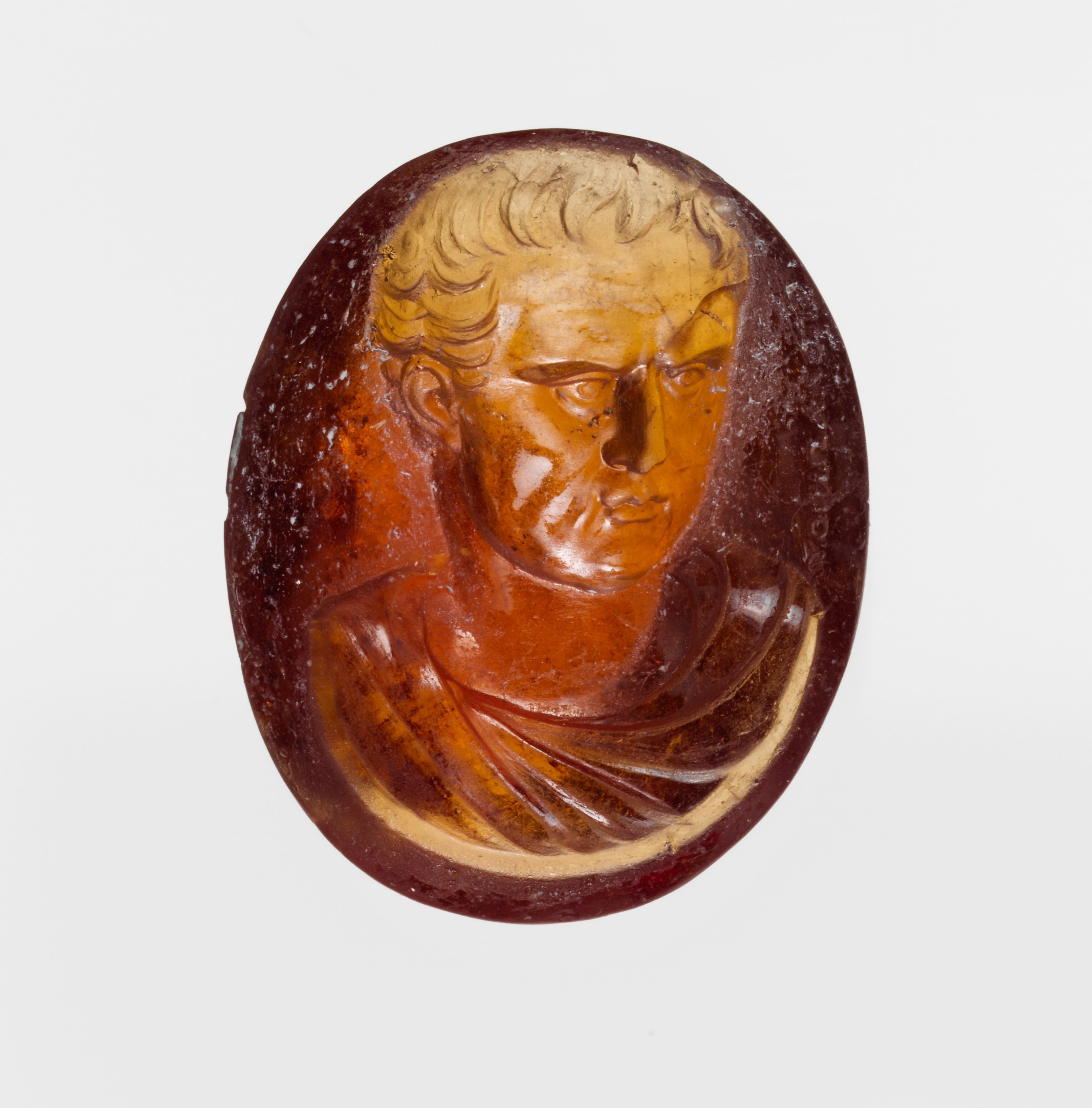
Roman Carved Garnet Stone signed by Apollonios, 1st Century BCE.
Garnet has long held deep religious significance, for example, to early Christian theologians who saw the stone as more than a symbol of power, prestige, and protection; to them, it was the blood of Christ, resurrection and eternal life. Ambrose, Bishop of Milan in the late fourth century, linked the glow of the red stone to ideas of vitality and the spirit, describing ‘a bright garnet, in which something of the little flame of our soul lives’. Similarly, eighth century monk Ambrosius Autpertus interpreted the contrasting appearance of the garnet, dark in colour but coming alive under the light, as a metaphor for the incarnation and Christ’s two natures - the human and the divine. According to Judeo-Christian tradition, King Solomon wore garnets into battle as a symbol of protection and power, as did both Christian and Muslim warriors during the medieval crusades as a spiritual safeguard. Legend even recounts that Noah used the gemstone to light the inside of the ark, highlighting the idea of garnet’s inner, sacred light, and in Europe, during the Middle Ages, garnets were favoured by the clergy and nobility as symbols of Christ’s blood and sacrifice. Through centuries of legend, theology and devotion, garnet has emerged as an emblem of faith, protection, and the living spirit.
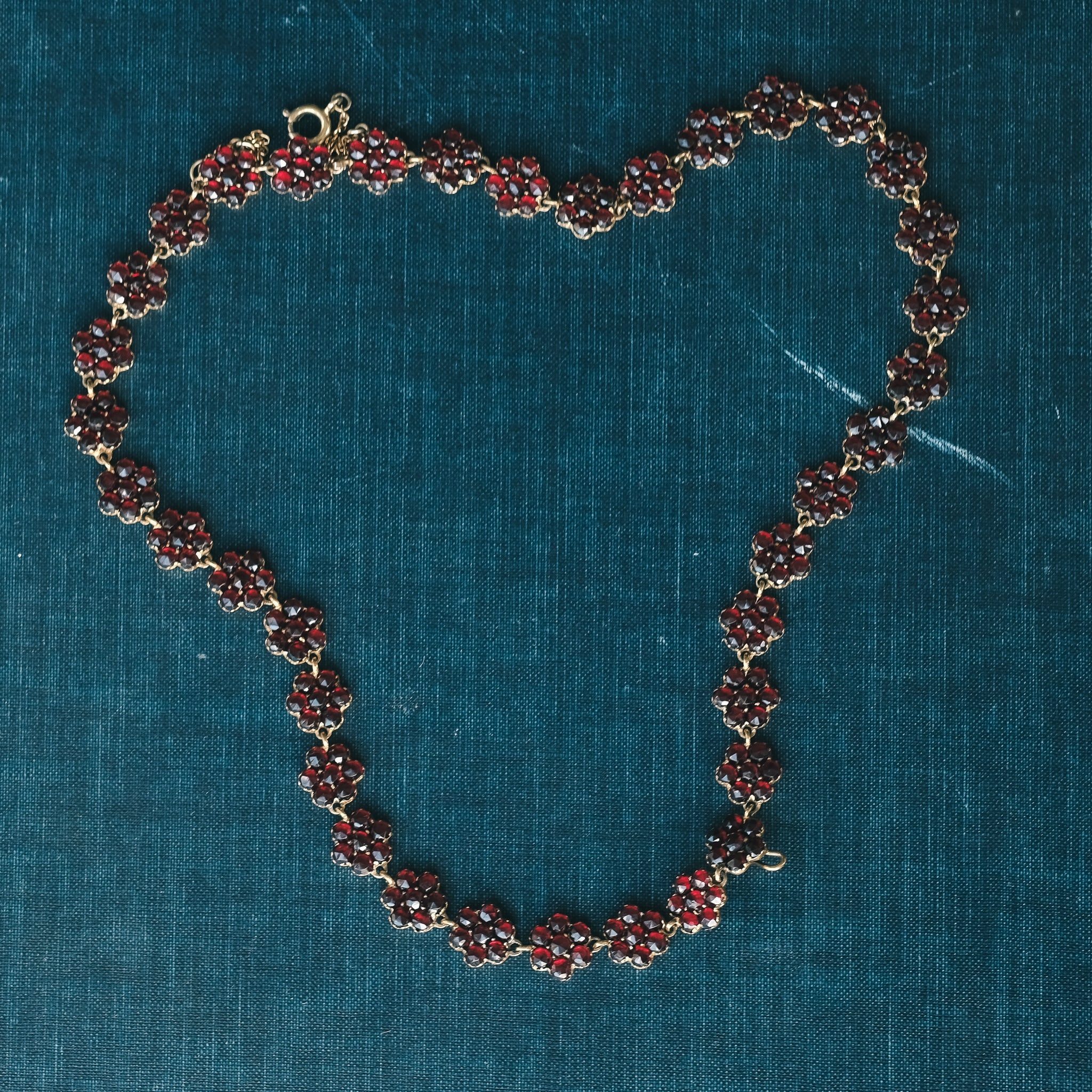
Despite a slight decline in popularity as a result of political upheaval disrupting those same supply routes that caused an upsurge in trade, the discovery of the Czech garnet deposits in the sixteenth century increased production significantly, with Bohemian garnet jewellery becoming immensely fashionable. In the Georgian era, garnet was used widely in jewellery, though it was often set in more understated designs than the later Victorian styles, and the gemstones were generally cut into cabochons or rose cut garnets. During the Victorian period, garnet gained widespread popularity, often featuring carved or faceted gemstones in the form of cluster rings and pendants. The Victorians had a deep appreciation for sentimental jewellery, and garnet’s association with love, loyalty, and protection made it the perfect choice for the era’s romantic aesthetic. As the Edwardian era ushered in a more delicate, refined aesthetic, garnet jewellery featured lighter, more open designs, often paired with diamonds and set into platinum or white gold enabled by technological advancements within the industry. By the time the Art Deco period arrived, garnet had become part of the broader movement towards bold designs, being incorporated into vibrant, modern designs with sharp lines and a more stylised and geometric aesthetic. During this period, garnets were frequently paired with materials like onyx, diamond, and enamel to create striking, high contrast pieces that were both fashionable and artistic.
Today, garnet continues to be a popular gemstone in both antique and modern jewellery, both for its historical significance and its ability to add depth and warmth to any piece. Its versatility has provided it with an illustrious, multi-millennial history, stretching across cultures and civilisations with its deep, vibrant hues remaining a timeless symbol of passion, protection, and vitality.
The Specifics
Composition: X3Y2(SiO4)3 (where X and Y vary by species)
Crystal System: Isometric (Cubic)
Lustre: Vitreous
Inclusions: Needle-like crystals, stress cracks
Colour: Colourless, pink, red, orange, yellow, green, purple, brown and black
Refractive Index (RI): 1.70 to 1.89
Transparency: Transparent to transluscent
Hardness: 6.5 to 7.5